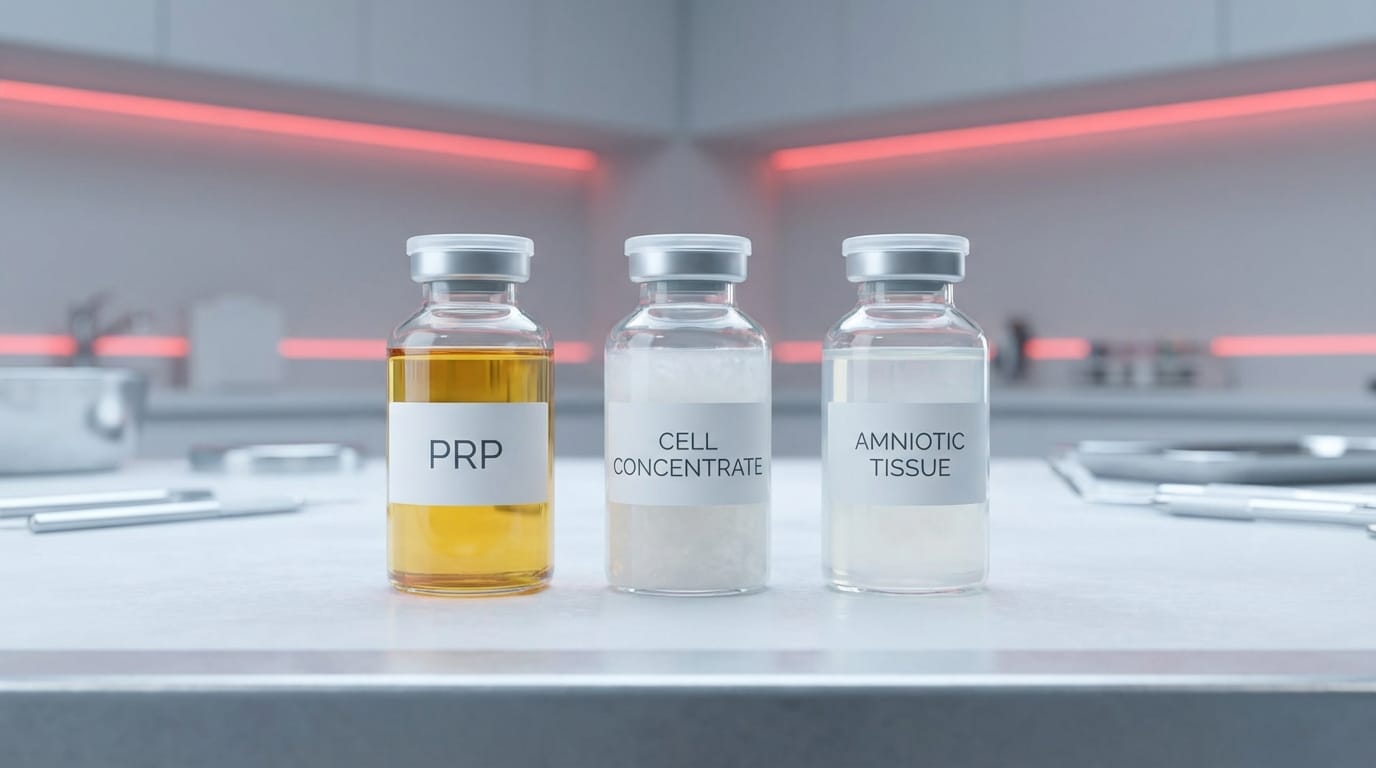
PRP vs Stem Cell vs Amniotic Tissue: Comparing Regenerative Options
Walk into any orthopedic clinic that offers regenerative medicine services and you’ll find patients asking the same question: “Should I get PRP, stem cells, or amniotic tissue?” They’ve read articles online, heard from friends, or seen advertisements from clinics positioning these treatments as alternatives to surgery. The question sounds simple. The answer is not.
These three product categories — platelet-rich plasma (PRP), bone marrow aspirate concentrate (BMAC, commonly marketed as “stem cell therapy”), and amniotic tissue products — are fundamentally different in their biology, preparation, evidence base, regulatory status, cost, and clinical applications. Comparing them as interchangeable “regenerative” options is like comparing an antibiotic, a steroid, and a bandage because they all “treat infections.” They work through different mechanisms and are appropriate for different clinical scenarios.
This article provides a direct, evidence-based comparison of all three categories — what each one actually is, what it does biologically, where the published data supports its use, where it doesn’t, and how to think about selecting the right option for a specific clinical situation.
What Each Product Actually Is
Platelet-Rich Plasma (PRP)
PRP is the patient’s own blood, drawn and processed through centrifugation to concentrate the platelet fraction. A typical PRP preparation concentrates platelets to 3-8 times the baseline blood concentration. Platelets contain alpha granules packed with growth factors — PDGF, TGF-beta, VEGF, EGF, IGF-1, and others — that are released when the platelets are activated.
PRP is an autologous product. It comes from the patient, is processed at the point of care (usually in 15-30 minutes), and is delivered back to the patient during the same visit. There is no disease transmission risk, no immune rejection risk, and no donor-related variability. The trade-off is that the biological potency of the preparation depends on the patient’s own blood composition — a patient with low platelet counts will produce a lower-quality PRP.
PRP preparations are not all the same. Leukocyte-rich PRP (LR-PRP) contains concentrated white blood cells along with platelets, producing a more pro-inflammatory effect. Leukocyte-poor PRP (LP-PRP) removes most white blood cells, creating an anti-inflammatory preparation. The optimal formulation varies by indication, and different commercial centrifugation systems produce different compositions.
Bone Marrow Aspirate Concentrate (BMAC / “Stem Cell Therapy”)
BMAC is produced by aspirating bone marrow — usually from the posterior iliac crest under local or general anesthesia — and concentrating it through centrifugation. The concentrate contains mesenchymal stem cells (MSCs), hematopoietic progenitor cells, platelets, growth factors, and cytokines.
The mesenchymal stem cell component is what drives the “stem cell therapy” label, but the actual MSC concentration in BMAC is low. Bone marrow contains approximately 1 MSC per 10,000-50,000 nucleated cells, and even after concentration, the absolute number of MSCs in a typical BMAC preparation is modest compared to culture-expanded stem cell therapies used in clinical trials. BMAC is more accurately described as a concentrated bone marrow product with stem cell content, not a pure stem cell therapy.
BMAC is also autologous, but the harvest procedure is more involved than a blood draw. Bone marrow aspiration from the iliac crest carries risks including pain at the harvest site, infection, hematoma, and rarely, pelvic fracture. The procedure typically requires conscious sedation or general anesthesia, which adds cost and complexity compared to PRP.
Amniotic Tissue Products
Amniotic tissue products are derived from human placental tissue donated after cesarean delivery. They include processed amniotic membrane (sheets, particles, or micronized forms) and amniotic fluid preparations. Unlike PRP and BMAC, amniotic tissue is an allogeneic product — it comes from a donor, not the patient.
Amniotic tissue contains a collagen scaffold, growth factors (EGF, TGF-beta, bFGF, PDGF, VEGF), anti-inflammatory cytokines (IL-1Ra, TIMPs), and hyaluronic acid. It does not contain a significant stem cell population, despite marketing claims from some vendors. Its biological activity is driven by its growth factor content, structural scaffold properties, and anti-inflammatory/anti-fibrotic effects.
Amniotic tissue products are available in multiple forms — dehydrated sheets, cryopreserved membranes, injectable micronized preparations, and amniotic fluid-based injectables. Each form has different handling requirements, shelf life, and clinical applications. For a detailed overview, see our amniotic tissue article.
Mechanism of Action: How They Work Differently
Understanding the different mechanisms is critical for appropriate clinical selection:
PRP works primarily through growth factor delivery and inflammation modulation. When platelets are activated (either through the injection process or by contact with damaged tissue), they release growth factors that recruit repair cells to the injury site, stimulate cell proliferation, and promote angiogenesis. The effect is essentially a biological signal boost — amplifying the body’s existing healing response. PRP does not provide new cells or a structural scaffold. It provides chemical signals.
BMAC works through a combination of stem cell delivery, growth factor signaling, and immunomodulation. The MSCs in BMAC can potentially differentiate into bone, cartilage, tendon, or other connective tissues (depending on the local biological environment). But the paracrine effects of MSCs — the growth factors and cytokines they secrete — may be more important than their direct differentiation. MSCs also have immunomodulatory properties, suppressing inflammatory responses that can impair healing. BMAC additionally contains platelets and their associated growth factors, so it provides overlapping PRP-like effects plus the stem cell component.
Amniotic tissue works through scaffold provision, growth factor delivery, and anti-inflammatory/anti-fibrotic activity. The collagen matrix provides a physical scaffold for tissue repair. The growth factors promote healing. The anti-inflammatory cytokines and hyaluronic acid reduce inflammation and scar formation. Amniotic tissue does not provide living stem cells in a clinically meaningful way (despite some marketing claims). Its value is as a multi-functional biologic environment, not as a cell therapy.
The key distinction: PRP is a signal amplifier. BMAC is a signal amplifier plus a cell source. Amniotic tissue is a scaffold plus a signal source plus an inflammation modulator. Each fills a different biological role.
Evidence Comparison by Indication
Knee Osteoarthritis
PRP: The strongest evidence in this comparison. Multiple randomized controlled trials and systematic reviews have shown that PRP injections (particularly LP-PRP) provide superior and longer-lasting pain relief compared to hyaluronic acid injections and corticosteroid injections for mild to moderate knee OA. The treatment does not regenerate cartilage, but it reduces symptoms, potentially through anti-inflammatory and trophic effects on the joint environment. Duration of benefit is typically 6-12 months.
BMAC: Promising but less established. Prospective studies have shown symptom improvement after BMAC injection for knee OA, and some MRI studies suggest preservation or modest improvement of cartilage quality. However, well-powered randomized controlled trials comparing BMAC to PRP or placebo are limited. The higher cost and invasiveness of the harvest procedure need to be justified by superior outcomes, and that case has not been definitively made.
Amniotic tissue: Early data with small sample sizes. Some prospective studies show symptom improvement, but randomized controlled trials with appropriate controls are lacking. The evidence is insufficient to draw firm conclusions about efficacy compared to PRP or BMAC for this indication.
Tendinopathy (Tennis Elbow, Patellar Tendinopathy, Achilles)
PRP: Mixed results that depend on the specific tendon, chronicity of the condition, and PRP formulation. For lateral epicondylitis (tennis elbow), multiple studies show benefit, particularly for chronic cases that have failed conservative treatment. For patellar and Achilles tendinopathy, the evidence is less consistent. LR-PRP may be preferred for tendinopathy because the pro-inflammatory leukocyte component may help restart a stalled healing response in chronically degenerated tendons.
BMAC: Limited data for tendinopathy as a standalone injection therapy. More commonly used as a surgical adjunct (applied to tendon repairs) rather than as a standalone injection.
Amniotic tissue: Limited clinical data for tendinopathy injection therapy. Used more commonly as a surgical augmentation product wrapped around tendon repairs than as a standalone injection.
Rotator Cuff Repair Augmentation
PRP: Mixed results. Some studies show improved healing rates when PRP is applied to the repair site during surgery, while others show no significant difference. The variability in results likely reflects differences in PRP preparation, delivery method, and tear characteristics.
BMAC: Early positive data. Small studies and case series suggest that BMAC augmentation of rotator cuff repairs may reduce retear rates, particularly for large and massive tears. The biological rationale is strong — delivering stem cells and growth factors directly to the repair site — but larger trials are needed.
Amniotic tissue: Encouraging preliminary data for rotator cuff augmentation. The anti-inflammatory and anti-fibrotic properties make biological sense for a repair that fails in part due to inflammation and scar-mediated retraction. Prospective trials are in progress.
Spinal Fusion
PRP: Not commonly used as a standalone bone graft substitute. Some data supports PRP as a graft supplement when combined with autograft or allograft, but the evidence is mixed and PRP alone does not provide the osteoinductive or osteogenic properties needed for reliable spinal fusion.
BMAC: Supported by stronger evidence as a graft supplement in spinal fusion. The MSCs in BMAC provide osteogenic potential, and several studies have shown fusion rates with BMAC-augmented grafts that approach autograft rates. BMAC combined with an osteoconductive scaffold (allograft or ceramic) is an increasingly common alternative to iliac crest autograft.
Amniotic tissue: Limited evidence for fusion augmentation. More commonly used in spine for epidural adhesion prevention than as a fusion biologic.
Cost and Practical Considerations
Cost differences between these products are significant and affect clinical decision-making:
PRP is generally the least expensive option. The cost is primarily the centrifugation kit ($200-500 per kit) plus the physician’s time for the blood draw and preparation. Total patient cost typically ranges from $500 to $1,500 per injection, depending on the practice and formulation. PRP requires no donor tissue, no special storage, and minimal preparation time.
BMAC is more expensive due to the bone marrow aspiration procedure. The centrifugation kit costs are similar to PRP, but the harvest procedure requires additional time, often sedation or anesthesia, and carries higher professional fees. Total patient cost typically ranges from $2,000 to $5,000 or more, depending on the clinical setting and whether the procedure is performed in an office, ASC, or hospital.
Amniotic tissue products vary widely in cost depending on the specific product, form factor, and volume. Injectable amniotic tissue preparations can range from $1,000 to $3,000 per unit. Sheet membranes for surgical augmentation can range from $500 to $2,500 or more per graft. Because these are manufactured products with processing, storage, and distribution costs, they carry margins that reflect the supply chain.
Insurance coverage for all three categories is inconsistent. PRP is covered by some payers for specific indications (particularly knee OA in some commercial plans) but is often out-of-pocket. BMAC is generally not covered by insurance for most orthopedic indications. Amniotic tissue coverage depends on the product, the indication, and the payer.
Regulatory Differences
PRP: The centrifugation equipment is FDA-cleared as a medical device. The PRP preparation itself is not separately regulated as a drug or biologic because it is an autologous, minimally manipulated, homologous-use tissue product prepared at the point of care. No premarket approval is required for the PRP itself.
BMAC: Same regulatory framework as PRP. The centrifugation equipment is FDA-cleared. The BMAC preparation is considered a minimally manipulated autologous tissue product. If the bone marrow cells were to be culture-expanded (grown in a lab to increase cell numbers), the product would be regulated as a drug under IND requirements. Point-of-care BMAC without culture expansion is not subject to premarket approval.
Amniotic tissue: Most amniotic tissue products are regulated as HCT/Ps under Section 361 of the Public Health Service Act, provided they meet criteria for minimal manipulation, homologous use, no combination with drugs/devices, and no systemic effect. Products that don’t meet all four criteria may require BLA or device clearance. The FDA has been actively enforcing these criteria, and several manufacturers have received warning letters for marketing products outside the HCT/P framework.
For a broader understanding of how biologics fit into orthopedic practice, see our complete biologics overview.
Clinical Selection: When to Use What
Based on the current evidence and biological rationale, here is a practical framework for clinical selection:
Use PRP when:
- Treating knee osteoarthritis (best evidence of the three for this indication)
- Treating chronic tendinopathy that has failed conservative management
- Cost is a primary constraint (least expensive option)
- The clinical goal is inflammation modulation and growth factor delivery without the need for stem cells or a structural scaffold
- An office-based procedure is preferred (simple blood draw, no bone marrow harvest)
Use BMAC when:
- Augmenting bone healing in spinal fusion or fracture nonunion (osteogenic potential is the key differentiator)
- Treating larger cartilage defects where stem cell differentiation is desirable
- Augmenting tendon or ligament repairs during surgery (where the harvest can be done under the same anesthesia)
- The clinical scenario demands the maximum biologic potency available at the point of care
Use amniotic tissue when:
- The clinical goal is anti-adhesion or anti-fibrotic effect (epidural application in spine, nerve wrapping)
- Surgical augmentation of soft tissue repairs where a physical scaffold plus growth factors is beneficial
- An allogeneic product is preferred (no harvest procedure required)
- Anti-inflammatory modulation of the joint or surgical site environment is the primary goal
These categories are not always mutually exclusive. Some surgeons use PRP or BMAC in combination with amniotic tissue products to provide both autologous cellular/growth factor components and the scaffold/anti-inflammatory properties of the amniotic tissue.
Combination Use: Can They Be Used Together?
Combination use is increasingly common in clinical practice, though the evidence base for specific combinations is limited:
- BMAC + osteoconductive scaffold: This is the most established combination, widely used in spinal fusion. BMAC provides the osteogenic cells and growth factors, while the scaffold (allograft, ceramic, or DBM) provides the structural framework for bone formation.
- PRP + amniotic tissue: Some surgeons combine PRP activation with amniotic tissue application, theorizing that the platelet-derived growth factors complement the growth factors in the amniotic tissue. The evidence for this specific combination is anecdotal.
- BMAC + PRP: Since BMAC already contains platelets, the additive benefit of supplementing with additional PRP is questionable. Some practitioners add PRP to BMAC preparations anyway, but the biological rationale for this is weak.
- Amniotic tissue wrap + BMAC injection at repair site: Used in some rotator cuff and tendon repair protocols, with the amniotic tissue providing the anti-fibrotic scaffold and BMAC providing the cellular component. This is a biologically reasonable combination but lacks randomized trial support.
The challenge with combination approaches is isolating which component is driving the clinical effect. This makes evidence generation difficult and contributes to the overall evidence gap in regenerative orthopedics.
Marketing vs Reality
The regenerative medicine space has a marketing problem. Patient-facing advertising from some clinics overstates the evidence, conflates product categories, and makes claims that the published data does not support. This creates challenges for evidence-based practitioners and for sports medicine professionals who want to offer regenerative options within the bounds of what the science actually shows.
Common marketing distortions:
- “Stem cell therapy” for BMAC: BMAC contains stem cells, but the concentration is low and the product is more accurately described as concentrated bone marrow. True stem cell therapies involving culture-expanded cells are different products with different regulatory requirements.
- “Stem cells” in amniotic tissue: Most processed amniotic tissue products do not contain viable stem cells. The biological activity comes from growth factors and the collagen scaffold, not from stem cell activity. Labeling amniotic tissue injections as “stem cell therapy” is inaccurate.
- “Regenerates cartilage/tendons/joints”: No current regenerative medicine product has been proven to reliably regenerate articular cartilage in an osteoarthritic joint. PRP, BMAC, and amniotic tissue may improve symptoms and slow progression, but claims of structural regeneration in degenerative conditions are not supported by current evidence.
- Cherry-picked studies: Clinics sometimes cite small, uncontrolled, single-arm studies as evidence of efficacy while ignoring negative or equivocal results from better-designed trials. The evidence should be evaluated in totality, not selectively.
Device representatives selling into this space should be equipped to have honest, evidence-based conversations. Credibility with surgeons depends on acknowledging the limitations of the data alongside the strengths.
Frequently Asked Questions
Which regenerative treatment has the best evidence for knee osteoarthritis?
PRP has the strongest published evidence for knee osteoarthritis among the three options. Multiple randomized controlled trials and meta-analyses have demonstrated that PRP injections (particularly leukocyte-poor PRP) provide greater and longer-lasting symptom relief compared to hyaluronic acid and corticosteroid injections for mild to moderate knee OA. BMAC and amniotic tissue injections show promising results in smaller studies, but they lack the volume of high-quality randomized trial data that PRP has accumulated for this specific indication.
Is BMAC really “stem cell therapy”?
BMAC contains mesenchymal stem cells, but calling it “stem cell therapy” is an oversimplification. The MSC concentration in BMAC is low — approximately 1 MSC per 10,000-50,000 nucleated cells in the original bone marrow, and while centrifugation concentrates them, the absolute numbers remain modest. The therapeutic effects of BMAC likely result from a combination of MSC paracrine activity (growth factors and cytokines secreted by the cells), the platelet-derived growth factors also present in the concentrate, and the immunomodulatory properties of MSCs. True culture-expanded stem cell therapies, which involve growing millions of MSCs in a laboratory, are a different category with different regulatory requirements and are not available outside of clinical trials in the United States.
Can PRP, BMAC, or amniotic tissue replace surgery?
For some conditions, regenerative treatments may delay or prevent the need for surgery. PRP injections for knee OA, for example, may provide sufficient symptom relief to postpone knee replacement in patients with mild to moderate disease. For tendinopathy, regenerative injections may resolve symptoms without the need for surgical debridement. However, for structural problems like torn tendons, unstable joints, advanced arthritis with bone-on-bone changes, or spinal stenosis, regenerative injections are not a substitute for surgery. They are most appropriately positioned as treatments for early or moderate disease, or as adjuncts used alongside surgical procedures to enhance healing.
Why are prices so different between PRP, BMAC, and amniotic tissue?
The cost differences reflect differences in preparation complexity and product supply chain. PRP requires only a blood draw and a centrifugation kit — a simple, office-based procedure with low material costs. BMAC requires bone marrow aspiration (a more invasive procedure often requiring sedation), which adds procedural time, anesthesia costs, and professional fees. Amniotic tissue is a manufactured allogeneic product that involves donor tissue procurement, processing, preservation, quality testing, and distribution — a supply chain that adds cost at every step. The clinical question is whether the additional biological capability of BMAC or amniotic tissue justifies the cost premium over PRP for a given indication.