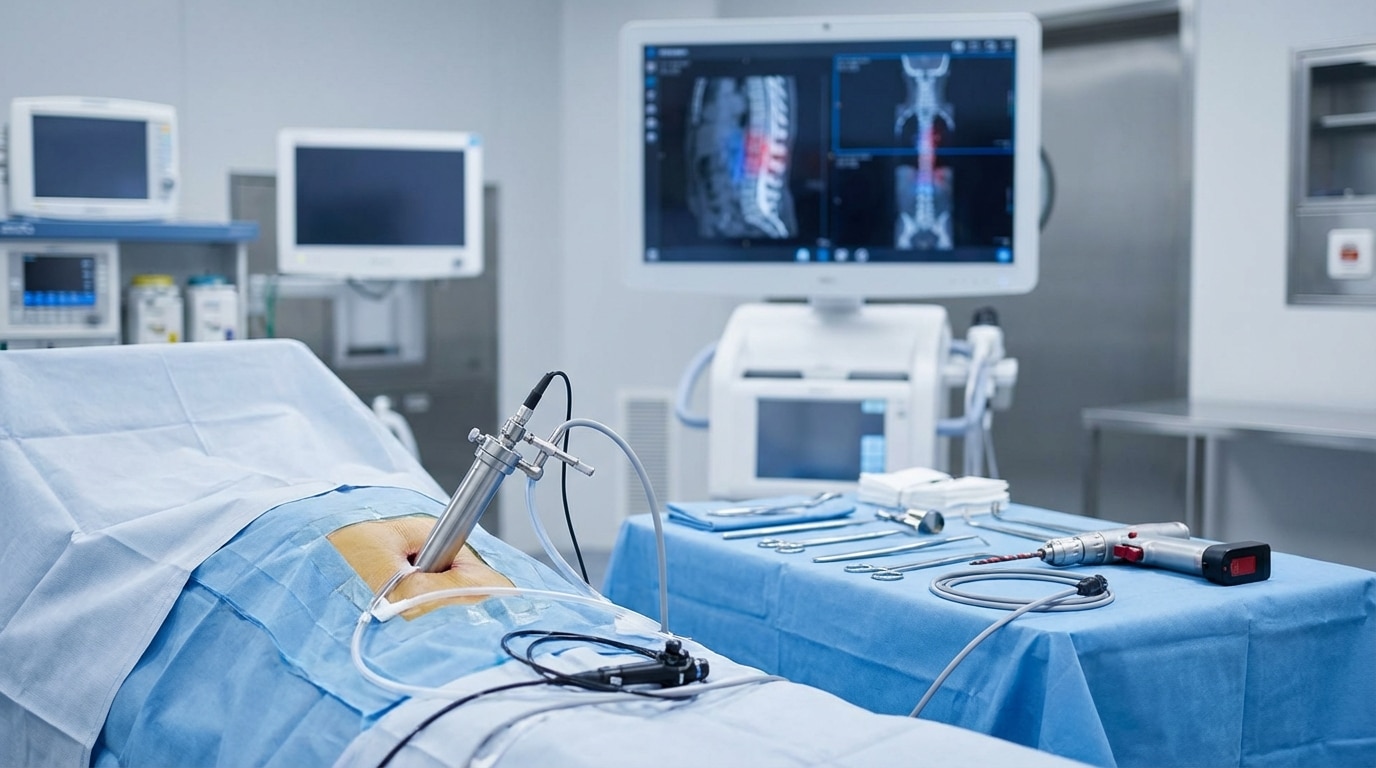
Minimally Invasive Spine Surgery Instrumentation: What’s New in 2026
Minimally invasive spine surgery instruments have moved from niche specialty tools to standard operating room equipment in under two decades. What started with tubular retractors and percutaneous pedicle screw systems has expanded into a full surgical ecosystem — endoscopic platforms, expandable interbody cages designed for narrow corridors, robotic guidance systems, and navigation-integrated instruments that know exactly where they are in three-dimensional space before the surgeon commits to a trajectory.
The premise of MIS spine surgery has not changed: achieve the same clinical objectives as open surgery (decompression, stabilization, fusion) through smaller incisions with less muscle destruction, less blood loss, shorter hospital stays, and faster recovery. What has changed in 2026 is the instrumentation. The tools have caught up with the ambition. Procedures that were technically feasible but practically difficult five years ago are now reproducible, teachable, and scalable.
This guide covers the current state of MIS spine instrumentation: what is available, what has changed recently, and what matters operationally for surgical teams and the device professionals who support them.
Tubular Retractor Systems
The tubular retractor is the defining instrument of MIS spine surgery. A series of concentric dilators is passed through a small skin incision over the target anatomy, progressively separating the paraspinal muscle fibers without cutting them. The final tubular retractor (typically 18mm, 22mm, or 26mm inner diameter) provides a working corridor from the skin to the spine through which the entire decompression and fusion procedure is performed.
Current tubular retractor systems have refined several aspects of the original concept:
- Expandable retractors — bladed retractors that insert at a narrow profile and expand after docking, providing a larger working area than a fixed-diameter tube without a larger skin incision. These are particularly useful for MIS TLIF where the surgeon needs to work across the disc space and the contralateral side.
- Articulating arms — table-mounted articulating arms that hold the retractor in position without an assistant, freeing both of the surgeon’s hands. Modern arms offer finer adjustment, more rigid fixation, and faster repositioning than earlier generations.
- Integrated illumination — LED or fiber-optic light sources built into the retractor blade or attached to the retractor ring, improving visualization at the bottom of a deep, narrow corridor where external headlight or microscope light may be inadequate.
- Retractor-compatible instruments — the entire instrument set (Kerrison rongeurs, curettes, disc preparation tools, cage inserters) is designed with extended shafts, bayoneted profiles, and narrow working ends optimized for use through a tubular corridor. Standard open instruments do not work through a tube.
The learning curve for working through a tube is real. The visual field is narrow, the working angles are constrained, and depth perception through a microscope or loupe at the end of a 6-8cm corridor is different from open surgery. Simulation training and proctored cases remain important for surgeons adopting tubular techniques.
Percutaneous Pedicle Screw Systems
Percutaneous pedicle screw placement eliminates the need for open exposure of the posterior spine for screw insertion. Each screw is placed through a 15-20mm stab incision using a Jamshidi needle to access the pedicle under fluoroscopic guidance, followed by guidewire placement, tapping over the wire, and cannulated screw insertion over the wire.
The screws have extender tabs — temporary extensions that project above the skin surface and allow the surgeon to manipulate the screw and capture the rod without direct visual access to the screw head. After the rod is passed through the extender tabs and seated in the screw heads, set screws are tightened through the extenders, and the extender tabs are broken off and removed.
What Has Changed in Percutaneous Screw Design
- Lower-profile extenders — earlier systems had tall, bulky extender towers that limited the number of levels that could be instrumented through a single working space. Current designs have reduced extender height and diameter, making multi-level instrumentation more manageable.
- Reduction capability through percutaneous systems — modern percutaneous reduction screws can achieve spondylolisthesis reduction through the extender mechanism, a capability that previously required open surgery. The extender tab provides the mechanical advantage to reduce the rod into the screw head while simultaneously translating the vertebral body.
- Pre-loaded set screws — set screws that are pre-mounted in the screw head before insertion, reducing the number of steps and instrument exchanges during the locking sequence.
- Navigation-compatible screws — screws and insertion instruments with navigation reference markers, allowing tracked placement without fluoroscopy. This reduces radiation exposure to the surgical team and improves accuracy, particularly in the thoracic spine where pedicle anatomy is smaller and more variable.
Expandable Interbody Cages for MIS
Expandable interbody cages were developed specifically to solve the MIS access problem: how to place a cage large enough to provide adequate disc height restoration and endplate coverage through a corridor narrow enough to qualify as minimally invasive.
The cage is inserted at a compressed profile (typically 8-9mm in height) through the tubular retractor or percutaneous corridor, then expanded in situ to the desired height (up to 14-16mm or more) using a mechanical actuator. Some designs also offer lordosis adjustment — the cage can be expanded asymmetrically to create segmental lordosis, addressing sagittal alignment correction without the need for an anterior approach.
Current Design Trends
- Articulating inserters — cage insertion instruments that articulate at the tip, allowing the cage to be steered into position across the disc space from a posterolateral approach without requiring the straight-line trajectory that fixed-angle inserters demand.
- Expandable lordotic cages — cages that expand not just in height but with a built-in lordotic angle, providing 10-20 degrees of segmental lordosis correction. This addresses the sagittal balance correction that was previously achievable only through ALIF or pedicle subtraction osteotomy.
- 3D-printed titanium expandable cages — combining the porous surface advantages of additive-manufactured titanium (bone ingrowth at the endplate interface) with the insertion advantages of an expandable design. These represent the convergence of two major trends in spine device development.
- Integrated screw fixation — some expandable cages now incorporate screws that deploy through the cage into the adjacent vertebral bodies after expansion, providing standalone fixation without supplemental posterior instrumentation in select cases.
Endoscopic Spine Surgery Instrumentation
Full-endoscopic spine surgery represents the most minimally invasive end of the spectrum — an entire discectomy or foraminotomy performed through a 7-8mm working channel endoscope under continuous saline irrigation and direct endoscopic visualization. No tubular retractor, no microscope, no muscle splitting beyond the endoscope diameter.
Endoscopic spine surgery instrumentation in 2026 includes:
- Multi-channel endoscopes — newer scopes with dedicated irrigation, suction, and working channels that reduce instrument exchanges and improve flow management during the procedure.
- Powered endoscopic instruments — high-speed endoscopic drills, endoscopic ultrasonic bone curettes, and radiofrequency probes designed to work through the endoscope’s 4-5mm working channel. These tools allow bony decompression (foraminoplasty, laminotomy) that was previously impossible through an endoscope.
- Endoscope-assisted interbody fusion — a growing category where the endoscope is used for disc preparation and decompression, and a small expandable cage is placed through the endoscopic corridor. This is still technically demanding and performed at relatively few centers, but the instrumentation is commercially available and improving.
- 3D endoscope systems — stereoscopic endoscopes that provide the surgeon with depth perception, addressing one of the primary limitations of traditional 2D endoscopic visualization.
The adoption curve for endoscopic spine surgery is steep. The instruments are specialized, the learning curve is significant (typically 50-100 cases to achieve consistent proficiency in transforaminal endoscopic discectomy), and the procedures require a fundamentally different spatial orientation than microscope-assisted or loupe-assisted surgery. But the clinical results in experienced hands are equivalent to microdiscectomy with significantly reduced tissue trauma, and the technology is progressing rapidly.
Lateral Access Platforms
Lateral lumbar interbody fusion (LLIF) instruments have evolved significantly from the original transpsoas platforms. Current systems include:
- Directional EMG neuromonitoring — stimulation probes that map the position of the lumbar plexus in real-time as the surgeon dilates through the psoas muscle. Current-generation systems provide directional feedback (the nerve is anterior, posterior, above, below) rather than simple threshold warnings, allowing more precise corridor selection.
- Anterior-to-psoas (ATP) retractor systems — instruments designed for the oblique lateral approach that passes anterior to the psoas muscle, avoiding the plexus entirely. ATP systems use a different retractor geometry and docking technique than transpsoas platforms but provide access to the same disc levels (typically L2-L5).
- Single-position lateral surgery — traditional lateral interbody fusion required the patient to be repositioned from lateral decubitus (for cage placement) to prone (for posterior screw placement). Single-position systems allow both the lateral cage and the percutaneous posterior screws to be placed with the patient in the lateral position, eliminating repositioning time and the associated anesthesia, sterility, and workflow disruptions.
- Wider cage options — lateral cages are now available in a broader range of widths, heights, and lordotic angles, including hyperlordotic (20-30 degree) cages for anterior column realignment (ACR) procedures that correct severe sagittal imbalance through the lateral approach.
Intraoperative Navigation in MIS Spine
Navigation is arguably more valuable in MIS spine surgery than in open surgery. In open procedures, the surgeon has direct visualization of anatomic landmarks and can palpate bony anatomy for screw trajectory confirmation. In MIS and percutaneous procedures, the surgeon works through narrow corridors without direct visualization of the anatomy — making image-guided navigation a significant safety and accuracy tool.
Current Navigation Modalities
- Intraoperative CT (O-arm, Airo, Loop-X) — a cone-beam CT scanner in the operating room acquires a 3D image set after the patient is positioned. Navigation instruments are tracked in real-time against this image, providing continuous feedback on trajectory, depth, and position. This is the current gold standard for navigated MIS pedicle screw placement.
- Preoperative CT-to-intraoperative registration — the navigation system uses a preoperative CT scan registered to the patient’s anatomy using intraoperative fluoroscopy or surface matching. Less expensive than intraoperative CT but subject to registration error, particularly if the patient’s position has changed the spinal alignment between the preoperative scan and the surgical position.
- Fluoroscopy-based navigation (2D-to-3D registration) — uses intraoperative fluoroscopic images registered to a preoperative CT to create a navigated environment. A middle-ground option that does not require a full intraoperative CT scanner.
Radiation Reduction
One of the strongest arguments for navigation in MIS spine surgery is radiation reduction. Percutaneous pedicle screw placement under fluoroscopic guidance requires repeated imaging to confirm guidewire and screw position — exposing the surgical team to cumulative radiation dose. Navigated screw placement reduces or eliminates intraprocedural fluoroscopy after the initial image acquisition. Published data show 50-70% reduction in intraoperative radiation exposure with navigation compared to fluoroscopy-guided percutaneous techniques.
Robotic Platforms for MIS Spine Surgery
Robotic-assisted spine surgery has matured from early-adopter technology to mainstream clinical tool. The four FDA-cleared robotic platforms currently in wide use are:
- Globus Medical ExcelsiusGPS — a floor-mounted robotic arm with integrated navigation. The robot positions a rigid drill guide at the planned screw entry point and trajectory. The surgeon drills and places the screw through the guide. The system integrates its own navigation camera and intraoperative imaging.
- Medtronic Mazor X Stealth Edition — integrates the Mazor robotic arm with Medtronic’s Stealth navigation platform and O-arm imaging. The robot provides guided screw trajectories planned on preoperative or intraoperative CT.
- NuVasive Pulse — a navigation and planning platform with robotic-assisted guidance capabilities, integrated with NuVasive’s implant and instrument ecosystem.
- Zimmer Biomet ROSA ONE Spine — a robotic platform with a sensor-equipped arm that tracks patient movement and adjusts the guide position in real-time to compensate for respiratory motion or patient shifting.
What Robotics Add to MIS Specifically
In MIS surgery, the robotic guide replaces the surgeon’s tactile feel for pedicle anatomy with a mechanically constrained trajectory based on imaging data. This is particularly valuable for:
- Percutaneous screw placement — the robot guides the Jamshidi needle or drill to the exact planned entry point and trajectory, reducing fluoroscopy and improving accuracy in a procedure where the surgeon has no direct visualization of the pedicle.
- Thoracic pedicle screws — smaller pedicles with less margin for error. Robotic guidance consistently achieves accuracy rates above 97% in the thoracic spine.
- Deformity correction — complex 3D deformity requires screw trajectories that may be unintuitive. The robot plans trajectories on the 3D dataset and executes them with mechanical precision.
- S2AI screws — the sacral alar-iliac trajectory passes through a long oblique path with no direct pedicle landmarks. Robotic guidance simplifies this technically challenging trajectory.
Augmented Reality Navigation
Augmented reality (AR) projects navigation data directly into the surgeon’s field of view through a headset or heads-up display. Instead of looking away from the surgical field to a separate navigation screen, the surgeon sees the planned trajectory, depth markers, and anatomic boundaries superimposed on the patient’s anatomy in real-time.
Several AR navigation systems are in clinical use or advanced development for spine surgery in 2026. The primary advantage is workflow: the surgeon maintains eyes-on-field positioning throughout the procedure, reducing the head-turning, refocusing, and spatial translation that traditional screen-based navigation requires. Early clinical data show comparable accuracy to standard screen-based navigation with improved operative flow.
The technology is still evolving. Current limitations include headset weight and comfort for long cases, display resolution in bright OR lighting, and the registration accuracy between the AR overlay and the actual patient anatomy. These are engineering problems being actively solved, not fundamental barriers.
The Convergence: Integration of Platforms
The most significant trend in MIS spine instrumentation in 2026 is platform convergence. The historically separate categories of instruments, implants, navigation, and robotics are merging into integrated ecosystems:
- Navigation-integrated instruments — insertion tools with embedded tracking markers that provide real-time positional data without separate reference frames. The instrument itself is the tracked object.
- Implant-specific planning software — preoperative planning platforms that not only plan screw trajectories but also simulate cage placement, height restoration, lordosis correction, and overall spinal alignment — with the actual implant geometries from the manufacturer’s catalog loaded into the software.
- Single-platform ecosystems — manufacturers offering a complete MIS spine solution from a single source: retractors, screws, cages, biologics, navigation, and robotic guidance all designed to work together. This reduces compatibility issues but raises vendor lock-in questions.
- Data integration — surgical data from navigation, robotics, and intraoperative imaging flowing into outcomes databases, creating feedback loops that inform future implant design, surgical technique, and device development.
For a broader look at spine instrumentation categories beyond MIS, see our spine surgery instrumentation guide and our spinal fusion devices guide.
Practical Considerations for Surgical Teams
Adopting MIS spine instrumentation is not just a purchasing decision — it is an operational transformation. Practical considerations include:
- Instrument tray complexity — MIS tray sets have more pieces, more specialized instruments, and less interchangeability than open sets. Surgical technologists need dedicated training on each system.
- OR setup time — navigation and robotic systems add setup time (15-30 minutes for calibration, registration, and draping). This is offset by procedural time savings in experienced hands, but the OR team must be trained and practiced in the setup workflow.
- Capital investment — robotic and navigation platforms represent $500K-$2M in capital equipment plus annual service contracts. The business case depends on case volume, competitive positioning, and whether the technology drives incremental surgical volume to the facility.
- Disposable costs — MIS procedures typically use more disposable components (dilators, guidewires, single-use instruments) than open cases. These per-case costs must be factored into the economic analysis.
- Supplier reliability — MIS instrumentation is more case-specific and less interchangeable than open instrumentation. A missing dilator size or an unavailable cage height is more disruptive in an MIS case because there are fewer workaround options. Supplier reliability and tray completeness are even more critical for MIS programs than for open programs.
Sourcing MIS Spine Instrumentation
SLR Medical Consulting supplies spine instrumentation — including MIS pedicle screw systems, interbody cages, and supporting hardware — to surgical facilities nationwide with zero-lead-time delivery from fully stocked warehouses. Complete tray sets, correct configurations, on your schedule. Browse our spine hardware catalog or place a surgical order.
Frequently Asked Questions About MIS Spine Instrumentation
What is the learning curve for minimally invasive spine surgery techniques?
The learning curve varies by procedure. Percutaneous pedicle screw placement is typically achievable within 15-20 cases for a surgeon experienced in open posterior fixation. MIS TLIF through a tubular retractor requires approximately 30-50 cases to reach consistent proficiency. Full-endoscopic discectomy has the steepest curve — most published data suggest 50-100 cases to achieve outcomes and complication rates equivalent to microdiscectomy. Navigation and robotic guidance can shorten these curves by providing real-time trajectory feedback, but they do not eliminate the need for hands-on training and proctored cases.
Does robotic-assisted spine surgery improve clinical outcomes compared to freehand or navigated techniques?
Robotic assistance consistently improves screw placement accuracy — published accuracy rates exceed 97% for robotic-guided pedicle screws compared to 85-92% for freehand placement. However, the evidence that improved accuracy translates to better clinical outcomes (less pain, better function, fewer reoperations) is still maturing. The strongest current evidence supports reduced radiation exposure for the surgical team, reduced screw-related complications (particularly in the thoracic spine), and potentially reduced revision rates for screw malposition. Long-term comparative outcomes studies are ongoing.
What are the main advantages of expandable interbody cages over static cages in MIS procedures?
Expandable cages offer three practical advantages in MIS surgery: (1) they insert through a smaller corridor because the cage profile is compressed during insertion, reducing the retractor size and soft tissue disruption needed; (2) they allow precise in-situ height adjustment — the surgeon can dial in the exact disc height and foraminal height after the cage is positioned, rather than committing to a fixed height during trial selection; (3) expandable lordotic designs provide sagittal plane correction that was previously achievable only through anterior or osteotomy approaches. The trade-off is mechanical complexity and cost — expandable cages have more components and higher per-unit pricing than static cages.
How does intraoperative navigation reduce radiation exposure in MIS spine surgery?
Traditional percutaneous pedicle screw placement requires repeated fluoroscopic images (AP, lateral, and oblique) at each step — needle insertion, guidewire confirmation, tapping, and screw placement. A multi-level MIS fusion can generate 2-5 minutes of cumulative fluoroscopy time. Navigation replaces this repeated fluoroscopy with a single intraoperative 3D image acquisition (O-arm spin or cone-beam CT), after which all instruments are tracked in real-time against the 3D dataset without additional radiation. Published studies show 50-70% reduction in total intraoperative radiation with navigation compared to standard fluoroscopic guidance, with the benefit concentrated in the surgical team’s exposure rather than the patient’s (since the initial 3D acquisition delivers a dose to the patient comparable to the cumulative fluoroscopic dose).
About SLR Medical Consulting: SLR Medical Consulting has been supplying surgical facilities nationwide for over a decade with orthopedic hardware, spine instrumentation, biologics, and sports medicine devices. Our zero-lead-time delivery model means your surgical schedule runs on your timeline, not your supply chain’s. Explore our hardware catalog or place a surgical order today.