How Orthopedic Implants Are Manufactured and Quality Tested
An orthopedic implant is not a fastener from a hardware store. It is a permanently implanted medical device that must bear millions of loading cycles inside a corrosive biological environment without fracturing, corroding, loosening, or releasing toxic debris into surrounding tissue. The orthopedic implant manufacturing process — from raw material certification to final sterile packaging — exists to guarantee that every screw, plate, rod, and joint component meets that standard before it enters an operating room.
This guide walks through the entire manufacturing chain: raw material selection, primary forming (forging, casting, additive manufacturing), precision machining, surface treatment, cleaning, inspection, quality testing, packaging, and sterilization. It is written for surgeons, device representatives, procurement professionals, and anyone involved in the orthopedic supply chain who needs to understand what separates a properly manufactured implant from one that should never touch a patient.
Raw Material Selection and Certification
Every implant starts as a certified bar, rod, sheet, or powder of medical-grade metal or polymer. The three primary materials in orthopedic implant manufacturing are:
- Ti-6Al-4V (Grade 5 titanium alloy) — the standard for fracture fixation hardware (screws, plates, nails), spine instrumentation (pedicle screws, rods), and many joint replacement components. It offers high strength-to-weight ratio, excellent biocompatibility, corrosion resistance, and MRI compatibility. Governed by ASTM F136 (wrought) and ASTM F1472 (forged).
- 316L stainless steel — used in fracture fixation plates and screws, temporary implants, and some instrument sets. Lower cost than titanium, easier to machine, stiffer (higher modulus). Governed by ASTM F138.
- Cobalt-chromium-molybdenum alloys (CoCrMo) — used in joint replacement bearing surfaces (femoral heads, tibial trays, femoral components) where wear resistance and hardness are critical. Both cast (ASTM F75) and wrought (ASTM F1537) forms are used depending on the component.
PEEK (polyether ether ketone) is the primary polymer used in orthopedic implants — most commonly in spine interbody cages and trauma applications where radiolucency is desired. Medical-grade PEEK (ASTM F2026) has a modulus of elasticity close to cortical bone, which reduces stress shielding.
Raw material certification is the first quality gate. The material supplier provides a Certificate of Conformance and a mill test report documenting chemical composition, mechanical properties (tensile strength, yield strength, elongation, hardness), and lot traceability. The implant manufacturer verifies this documentation and typically performs incoming inspection testing — spectrographic chemical analysis and mechanical testing on sample coupons — before releasing the material for production.
Forging: The Foundation of Structural Integrity
Forging is the preferred primary forming method for load-bearing orthopedic implants — particularly hip stems, knee femoral components, and large fracture fixation plates. In forging, a heated metal billet is pressed or hammered into a die that approximates the final shape. The compressive forces during forging align the metal’s grain structure along the contour of the part, creating a directional grain flow that follows the geometry of the implant.
This grain flow alignment is not cosmetic. It directly increases the component’s resistance to fatigue failure. A forged hip stem with grain flow running along its length will withstand significantly more loading cycles before crack initiation than a cast or machined-from-bar-stock component of identical geometry. Fatigue resistance is the critical mechanical property for any implant that must survive millions of gait cycles.
Forging also eliminates internal porosity and voids that can act as crack initiation sites. The compressive forming process closes any internal defects present in the raw bar stock, producing a component with full theoretical density.
After forging, the part is a near-net-shape blank — close to final dimensions but requiring precision machining to achieve the tolerances needed for screw threads, bearing surfaces, taper junctions, and mating features.
Investment Casting
Investment casting (lost-wax casting) is used for complex geometries that cannot be economically forged — particularly CoCrMo femoral components for total knee replacement and some hip femoral heads. The process involves creating a wax pattern of the implant, coating it in a ceramic shell, burning out the wax, and pouring molten metal into the resulting mold.
Cast CoCrMo components have a different microstructure than forged ones. The grain structure is equiaxed (random orientation) rather than directionally aligned, which means lower fatigue strength compared to a forged equivalent. To compensate, cast components undergo hot isostatic pressing (HIP) — a post-casting treatment where the component is subjected to high temperature and high-pressure inert gas simultaneously. HIP closes internal microporosity and improves mechanical properties.
The advantage of casting is geometric freedom. Complex femoral condyle geometry, tibial tray features, and porous surface textures can be produced in a single casting step that would require extensive (and expensive) multi-axis machining from a forged blank.
Additive Manufacturing (3D Printing)
Additive manufacturing has moved from prototyping curiosity to production reality in orthopedic implants. Two primary technologies are in use:
- Electron Beam Melting (EBM) — a powder bed fusion process using an electron beam in a vacuum chamber. Used primarily for titanium components. Produces fully dense parts with controlled porosity where designed. EBM-produced acetabular cups and spine interbody cages are FDA-cleared and in wide clinical use.
- Selective Laser Melting (SLM) / Direct Metal Laser Sintering (DMLS) — uses a laser to fuse metal powder in a layer-by-layer process. Produces higher-resolution features than EBM and is used for both titanium and CoCrMo components.
The transformative capability of additive manufacturing in orthopedics is designed porosity. Engineers can create lattice structures with controlled pore size (typically 300-900 microns), strut thickness, and porosity percentage that mimic the architecture of cancellous bone. These porous surfaces promote bone ingrowth — osteoblasts colonize the lattice, and new bone grows into and through the structure, creating biological fixation without cement.
3D-printed titanium interbody cages for spine surgery are now one of the fastest-growing product categories in orthopedics. The open-lattice design allows bone graft material packed inside the cage to communicate with the vertebral endplate through the porous cage walls, theoretically improving fusion rates compared to solid-walled PEEK or titanium cages.
Quality control for additive manufacturing is more complex than for forging or casting. Each build must be validated for dimensional accuracy, internal density (CT scanning is used to detect internal voids), microstructure, and mechanical properties. Build parameters (laser power, scan speed, layer thickness, hatching pattern) must be locked and validated, because small changes in these parameters can significantly alter the final part’s properties.
Precision CNC Machining
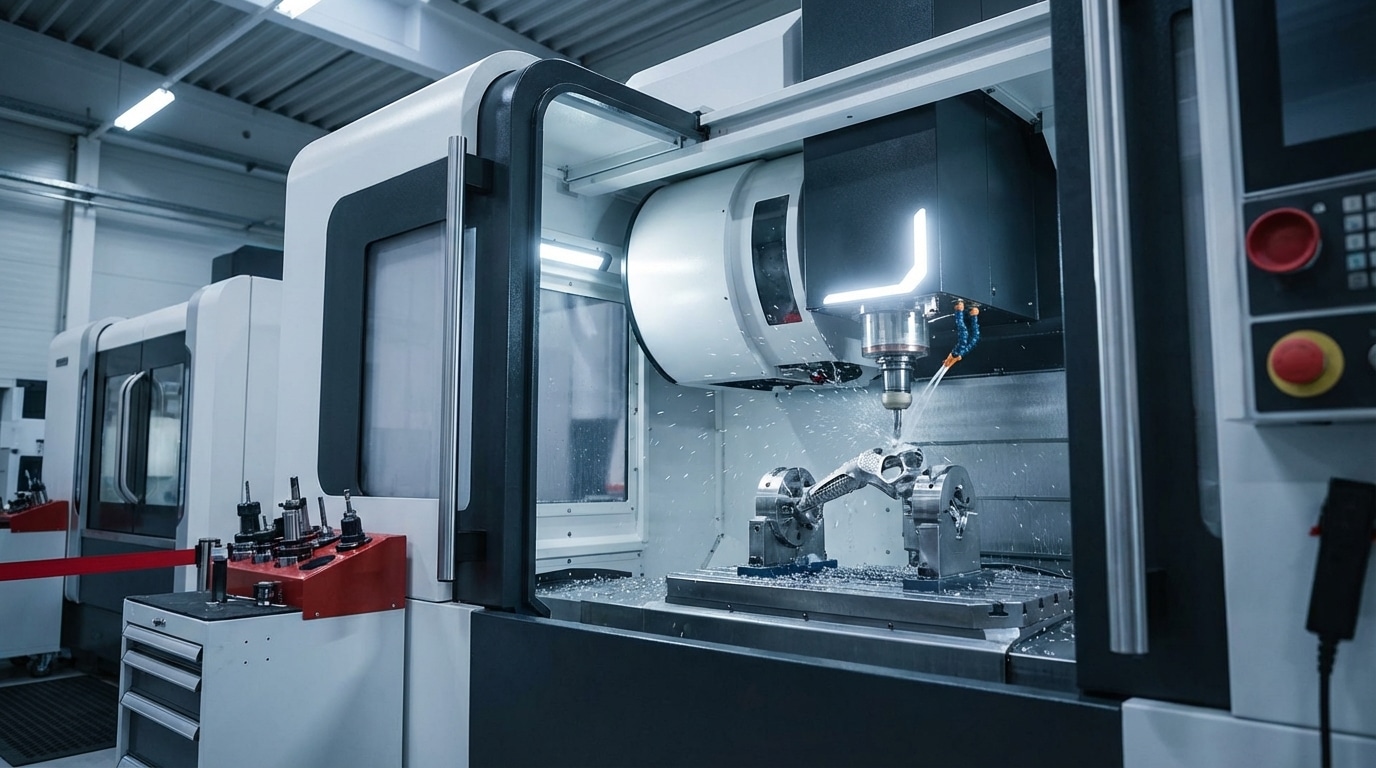
Regardless of the primary forming method, nearly every orthopedic implant requires precision CNC (computer numerical control) machining to achieve final dimensions and surface finishes. Machining operations include:
- Turning — used for cylindrical features (screw shafts, hip stem tapers, rod stock)
- Milling — used for flat surfaces, pockets, slots, and complex 3D contours (plate profiles, femoral component condylar surfaces)
- Threading — screw threads on orthopedic screws are single-point machined or thread-rolled for higher fatigue strength. Thread geometry (pitch, depth, lead, and profile) must be held to tight tolerances — a screw with incorrect thread dimensions will not engage the bone or plate properly
- Grinding — used for bearing surfaces on joint replacement components where surface finish requirements are in the sub-micron range (femoral heads, for example, require a surface roughness of Ra < 0.05 microns for metal-on-polyethylene bearings)
- Swiss-type machining — used for small-diameter screws (2.0mm-4.5mm) where the workpiece is fed through a guide bushing for precision. Most orthopedic screws are machined on Swiss-type CNC lathes
Dimensional tolerances on orthopedic implants are typically +/- 0.025mm to +/- 0.05mm for critical mating features (taper junctions, screw-plate interfaces, bearing surfaces). Non-critical dimensions may allow +/- 0.1mm or wider. Every dimension is specified on the engineering drawing, and the machining program is validated against these specifications during first-article inspection.
Surface Treatment and Finishing
Surface treatment serves both functional and biological purposes:
Mechanical Surface Treatments
- Shot peening — bombarding the surface with small steel or ceramic media introduces compressive residual stress in the surface layer. This compressive stress opposes the tensile stresses that initiate fatigue cracks, significantly improving fatigue life. Shot peening is standard for hip stems, screws, and any cyclically loaded implant.
- Tumbling/vibratory finishing — deburring and edge-rounding in a vibratory bowl with abrasive media. Removes machining burrs that could act as stress concentrators or damage tissue during implantation.
- Electropolishing — electrochemical material removal that produces an ultra-smooth, mirror-like surface finish. Used on stainless steel implants to improve corrosion resistance and reduce surface roughness.
Biological Surface Treatments
- Plasma spray (titanium or hydroxyapatite) — a rough porous coating applied to joint replacement components to promote bone ingrowth for cementless fixation. Titanium plasma spray (TPS) creates a surface roughness of 30-50 microns Ra. Hydroxyapatite (HA) coating adds an osteoconductive calcium phosphate layer that accelerates early bone apposition.
- Grit blasting — controlled abrasive blasting creates a rough surface texture (typically 3-6 microns Ra) that improves cement interlock on cemented components or promotes initial bone attachment on press-fit components.
- Anodization — electrochemical oxidation of titanium surfaces, creating a thicker oxide layer. Different oxide thicknesses produce different colors (the colored titanium screws and plates you see are anodized, not painted). Anodization can also improve wear resistance and corrosion performance. Color anodization is used for implant identification — different screw sizes may be color-coded for quick visual identification in the OR.
Cleaning and Passivation
After machining and surface treatment, implants undergo multi-stage cleaning to remove machining oils, cutting fluid residues, metallic debris, and particulate contamination. The cleaning process typically includes ultrasonic cleaning in aqueous detergent solutions, rinsing in deionized water, and drying in a clean environment.
Passivation is a chemical treatment (typically nitric acid or citric acid bath per ASTM A967) applied to stainless steel implants to remove free iron from the surface and enhance the protective chromium oxide layer. This step is critical for corrosion resistance — free iron on the surface acts as a corrosion initiation site in the body’s chloride-rich fluid environment. Titanium implants form a self-healing titanium oxide passive layer naturally, but cleaning protocols still remove any surface contamination that could interfere with biocompatibility.
Cleanliness validation includes particulate testing (counting particles per surface area), endotoxin testing (LAL assay to detect bacterial endotoxins), and residual chemical analysis. These are not optional quality checks — they are regulatory requirements with defined acceptance criteria.
Quality Testing and Inspection
Quality testing for orthopedic implants operates at multiple levels. For a deeper look at how different screw and plate types are designed, see our guide to orthopedic screws and plates.
Dimensional Inspection
Every critical dimension is verified. First-article inspection (FAI) measures every dimension on the drawing using coordinate measuring machines (CMMs), optical comparators, pin gauges, thread gauges, and surface profilometers. After FAI approval, in-process and final inspection use statistical sampling plans (typically per ANSI/ASQ Z1.4) to verify dimensional conformance on production lots.
Mechanical Testing
Mechanical testing is performed on representative samples from each material lot and each production lot (the frequency depends on the validated quality plan). Tests include:
- Tensile testing — measures ultimate tensile strength, yield strength, and elongation to failure. Verifies the material meets the specification (e.g., ASTM F136 requires Ti-6Al-4V to have a minimum yield strength of 795 MPa).
- Fatigue testing — cyclically loads samples or finished implants to a defined number of cycles (typically 5-10 million) at physiologically relevant loads. This is the most critical functional test for any load-bearing implant. ASTM F2193 (hip stems), ASTM F1717 (spinal constructs), and ASTM F382 (bone plates) define standardized fatigue test methods.
- Static bending and torsion — four-point bending tests for plates (ASTM F382) and torsion tests for screws measure resistance to single-event overload.
- Pullout and pushout testing — measures the force required to pull a screw out of bone or a bone substitute (synthetic bone blocks of defined density). Validates thread design effectiveness.
- Hardness testing — Rockwell or Vickers hardness measurements verify heat treatment effectiveness and material consistency.
Non-Destructive Testing (NDT)
- Dye penetrant inspection — fluorescent dye is applied to the surface, and after penetration time, excess dye is removed. The part is viewed under UV light; dye trapped in surface cracks fluoresces, revealing surface-breaking defects invisible to the naked eye.
- X-ray / CT inspection — radiographic examination detects internal voids, inclusions, and porosity. Particularly important for cast and 3D-printed components.
- Ultrasonic testing — high-frequency sound waves detect subsurface discontinuities in forged and bar-stock components.
Biocompatibility Testing
Materials used in implants must pass biocompatibility testing per ISO 10993 — a series of biological evaluation tests including cytotoxicity, sensitization, irritation, systemic toxicity, genotoxicity, and implantation studies. These tests are typically performed during initial material qualification rather than on every production lot, but the manufacturer must maintain documentation demonstrating biocompatibility for each material in contact with the patient.
Packaging and Sterilization
Finished, inspected, and cleaned implants are packaged in validated sterile barrier systems — typically a combination of inner pouches (Tyvek/film peel pouches or rigid blister trays) and outer protective packaging. The packaging must maintain sterile barrier integrity through storage, shipping, and handling until opened in the sterile field.
Terminal sterilization is most commonly performed by gamma irradiation (cobalt-60 source, typically at a dose of 25-40 kGy) or ethylene oxide (EtO) gas. Gamma irradiation is the standard for metallic implants — it penetrates packaging and implant without leaving residues. EtO is used for implants that incorporate polymer components sensitive to radiation (UHMWPE polyethylene, for example, can be degraded by excessive gamma exposure, though cross-linked polyethylene is specifically engineered with controlled radiation exposure).
Each sterilization cycle is validated with biological indicators (spore strips) and dosimeters to confirm the required sterility assurance level (SAL) of 10^-6 — meaning the probability of a non-sterile unit is less than one in a million.
Every sterile implant package includes: the implant with its catalog number and size, a lot number or serial number for traceability, the sterilization method indicator, an expiration date, and device labeling per FDA 21 CFR 801.
Regulatory Framework
Orthopedic implant manufacturing in the United States operates under FDA 21 CFR Part 820 — the Quality System Regulation (QSR), which establishes current Good Manufacturing Practice (cGMP) requirements for medical devices. Key requirements include:
- Design controls (design input, output, review, verification, validation, transfer)
- Document controls (drawings, specifications, procedures, work instructions)
- Production and process controls (validated manufacturing processes, in-process inspection)
- Corrective and preventive action (CAPA) systems
- Device history records (complete manufacturing record for each production lot)
- Complaint handling and medical device reporting (MDR) for adverse events
Most orthopedic implant manufacturers also maintain ISO 13485 certification — the international quality management system standard for medical devices. ISO 13485 is harmonized with FDA QSR requirements and is required for CE marking (European market access).
Implants are cleared for market through the 510(k) pathway (demonstrating substantial equivalence to a legally marketed predicate device) or the PMA (Premarket Approval) pathway for higher-risk devices. Most orthopedic screws, plates, and standard joint replacement components clear via 510(k). Novel bearing surfaces, new material formulations, or first-of-kind designs may require PMA with clinical data.
What This Means for the Supply Chain
Manufacturing an orthopedic implant from raw material to sterile packaged product takes weeks to months. Material procurement, forging or machining, surface treatment, cleaning, inspection, packaging, and sterilization each add time. For a surgical facility, this means the hardware sitting in the supply room represents months of upstream manufacturing and quality work.
When a supplier runs out of a specific screw size or plate length, restocking is not an overnight process. It requires either pulling from existing finished goods inventory elsewhere in the distribution chain or waiting for a new production run to complete. This is why inventory depth and supply reliability are non-negotiable criteria when choosing an implant supplier.
SLR Medical Consulting maintains fully stocked warehouses and zero-lead-time processing for orthopedic hardware, spine devices, and biologics. The manufacturing has already happened. The quality testing is complete. The implants are sterile and ready. When your facility needs hardware, it ships. Browse our catalog or place a surgical order. For guidance on selecting the right supplier, see our orthopedic surgical implants guide.
Frequently Asked Questions About Orthopedic Implant Manufacturing
Why are forged implants considered superior to cast or machined-from-bar implants?
Forging aligns the metal’s internal grain structure along the contour of the part, creating directional grain flow that significantly improves fatigue resistance — the ability to withstand millions of loading cycles without crack initiation. Forging also eliminates internal porosity and voids. Cast components have randomly oriented grain structure and may contain microporosity (even after HIP treatment), which reduces fatigue performance. Machined-from-bar components have the grain flow of the original bar stock, which may not align with the loading direction of the finished implant. For high-cycle fatigue applications like hip stems, forging is the preferred method.
How are 3D-printed orthopedic implants quality-tested differently from conventionally manufactured ones?
3D-printed implants require additional quality steps because the manufacturing process creates the material and the geometry simultaneously — unlike forging or machining, where the material properties are established before the part is formed. Each 3D-printed build must be validated for internal density (using CT scanning to detect voids), dimensional accuracy across the full geometry, microstructure (metallographic analysis of witness coupons built alongside the implant), and mechanical properties (tensile and fatigue testing of test bars from each build). Build parameter control (laser power, scan speed, powder quality, atmosphere) is critical because small variations can change the final part’s properties.
What does the ASTM F136 specification require for titanium implant material?
ASTM F136 specifies the chemical composition and mechanical properties for wrought Ti-6Al-4V ELI (Extra Low Interstitial) used in surgical implants. Key requirements include a minimum yield strength of 795 MPa, minimum ultimate tensile strength of 860 MPa, and minimum elongation of 10%. The “ELI” designation means reduced oxygen and iron content compared to standard Grade 5 titanium, which improves fracture toughness and fatigue performance. The specification also defines limits for interstitial elements (oxygen, nitrogen, carbon, hydrogen) that can embrittle the alloy if present above threshold levels.
What is the shelf life of a sterile-packaged orthopedic implant?
The shelf life of a sterile orthopedic implant depends on the packaging system and the manufacturer’s validated shelf-life testing. Most manufacturers validate shelf lives of 3-5 years from the date of sterilization. The expiration date is printed on each package. Shelf-life validation involves accelerated and real-time aging studies that demonstrate the sterile barrier system maintains its integrity (seal strength, microbial barrier) throughout the labeled shelf life under defined storage conditions. Using an implant past its expiration date is a regulatory violation and a patient safety risk — the sterile barrier may be compromised.
About SLR Medical Consulting: SLR Medical Consulting has been supplying surgical facilities nationwide for over a decade with orthopedic hardware, spine instrumentation, biologics, and sports medicine devices. Our zero-lead-time delivery model means your surgical schedule runs on your timeline, not your supply chain’s. Explore our hardware catalog or place a surgical order today.