How Independent Med Device Reps Choose Which Products to Carry
When you work W-2, your product line is decided for you. You sell what your employer makes. End of discussion.
When you go independent, you become the buyer. You decide which products fill your bag, which manufacturers you represent, and which distributor relationships you build your business around. This is one of the greatest advantages of the 1099 path. It is also one of the fastest ways to sink your business if you choose badly.
The wrong product line does not just cost you commission. It costs you time — months of calling on surgeons with products they do not want. It costs you credibility — standing in the OR with instruments that frustrate the surgeon. And it costs you opportunity — every hour spent pushing the wrong product is an hour you did not spend selling something that moves.
This post covers how experienced independent reps evaluate, select, and build a product portfolio that generates sustainable revenue. Not theory. The actual decision framework used by reps who have built territories producing $200K to $500K+ per year. For the broader picture of building a 1099 device business, start with our guide to building a 1099 medical device sales business.
The Product Selection Framework
Every product line you consider carrying should pass through five filters. If it fails any one of them, move on. There are too many options in this industry to waste time on product lines that are marginal on fundamentals.
Filter 1: Surgeon Demand in Your Territory
This comes first because it overrides everything else. A product with a beautiful margin profile and zero surgeon demand in your territory is a product that sits on the shelf.
Demand means surgeons in your geography are actively performing procedures that use this category of device. Not theoretical demand. Not “the market is growing.” Actual cases happening in actual ORs within driving distance of your house.
How to verify demand:
- Talk to OR staff. Scrub techs and circulators know exactly what products are being used in their ORs, how often, and by which surgeons. They also know which product categories are underserved — surgeons complaining about their current options, cases where product availability has been a problem, specialties where the local rep coverage is thin.
- Review your territory map. How many surgeons in your territory perform procedures that use this product category? If you mapped your territory properly (and you should have — see the territory-building guide), you know the case volume by specialty at each facility.
- Look at competitive displacement potential. Are surgeons currently using a competitor’s product in this category? If so, what is the switching cost? Some product categories have high switching costs (pedicle screw systems where the surgeon is trained on a specific set of instruments). Others have low switching costs (biologics, where the surgeon can trial a new product on the next case with minimal friction).
- Listen to what your surgeons ask for. If you are already covering cases with one product line and surgeons are asking “do you carry bone graft?” or “can you source an anchor system?” — that is demand data served directly to you. Pay attention.
Filter 2: Case Economics
The math has to work. For every product line, calculate two numbers:
Revenue per case: The average selling price of the product in a typical case, multiplied by your commission rate. This is your gross income per case covered.
Time per case: How many hours does this product require in terms of case coverage, pre-op prep, inventory management, and post-case documentation? Include travel time to the facility.
Divide revenue per case by time per case. That is your effective hourly rate for this product line. Compare it across every product line you are considering.
Example:
- Pedicle screw system: Average case sells $8,000 in hardware. Your commission at 30% of margin (assuming 50% margin) is $1,200 per case. Case coverage takes 4 hours plus 1 hour prep and 1 hour post-case. Effective rate: $200/hour.
- Biologic graft product: Average case sells $2,500 in biologic. Your commission at 40% of margin (assuming 60% margin) is $600 per case. But here is the key — the biologic goes into the same case as the hardware. Incremental time: 15 minutes. Effective incremental rate: $2,400/hour.
- Disposable arthroscopy kit: Average case sells $400 in disposables. Your commission at 25% of margin (assuming 40% margin) is $40 per case. Case coverage takes 2 hours. Effective rate: $20/hour.
The biologic add-on is the most profitable product in this example by a wide margin because it generates meaningful commission with almost no incremental time investment. The disposable kit is the worst because the case economics do not justify dedicated coverage.
This is why multi-line strategy matters. The most profitable independent reps are not the ones carrying the single highest-margin product. They are the ones stacking complementary products into the same cases. Hardware plus biologics plus supplementary instruments, all going to the same surgeon in the same OR on the same day. Three commission checks from one case investment.
Filter 3: Product Quality and Clinical Credibility
You will stand next to surgeons while they use your products on patients. If the product is substandard, you will know it and so will they. There is no amount of sales ability that compensates for an instrument system that jams, an implant that fails, or a biologic that underperforms clinically.
Evaluate product quality through:
- Surgeon feedback. If you know surgeons who have used the product (or a similar product from the same manufacturer), ask them directly. Not “is it good?” Ask specific questions: how does the instrumentation handle? Is the implant sizing consistent? How does intraoperative performance compare to their primary system?
- Clinical data. Does the product have published outcomes data? Peer-reviewed studies? FDA clearance pathway (510(k) vs. PMA)? Products cleared through the PMA pathway have gone through more rigorous clinical evaluation. Products with published outcomes in peer-reviewed journals give you ammunition in the selling conversation and credibility with evidence-driven surgeons.
- Instrument design and ergonomics. Get your hands on the instrument sets before you commit. Open every tray. Handle every instrument. Run through the surgical technique mentally. Are the instruments intuitive? Is the set organized logically? Do the implants seat cleanly in their trials? Surgeons notice these details. Poorly designed instrumentation creates friction in the OR that erodes your reputation.
- Manufacturing quality. Who makes it? Where? Under what quality system? Is the manufacturer FDA-registered? ISO 13485 certified? These are baseline requirements, not differentiators. If a manufacturer cannot produce these credentials, the product should not be on your radar.
For a closer look at the hardware side, explore SLR Medical’s orthopedic hardware portfolio.
Filter 4: Distributor Support for the Product Line
A great product with terrible distributor support is a liability. Evaluate how your distributor partner handles this specific product line:
- Inventory depth. Does the distributor stock a full range of sizes and configurations, or just the most common ones? When your surgeon needs a 7.5 x 50mm screw and it is not in the set, your case has a problem regardless of how good the rest of the system is.
- Set completeness. Are the instrument sets complete and well-maintained? Missing instruments, damaged components, or mixed sets from different system generations create chaos in the OR. The distributor is responsible for set integrity. Verify this before you commit.
- Replenishment speed. After a case, how quickly does the distributor replenish used implants? If you have back-to-back cases at different facilities, you need sets turned around fast. Same-day or next-day replenishment is the standard you should demand.
- Clinical training. Does the distributor provide formal training on this product line? Cadaver labs? Technique guides? In-service education for OR staff? Or are you expected to learn the product on your own? Training quality directly impacts your confidence and competence in the OR.
- Technical support. When something goes wrong — an instrument malfunctions, a surgeon has a question you cannot answer, a case requires a product configuration outside the standard set — can you call someone who knows the product and get an answer in minutes? Real-time technical support is not a luxury. It is a requirement for surgical products.
Filter 5: Competitive Position
Where does this product sit relative to what is already in your market? Three scenarios:
Clearly differentiated. The product offers something that the dominant competitor does not — a design feature, a material advantage, a surgical technique benefit, a price point that opens a segment the competitor cannot serve. This is the strongest position. You have a specific, articulable reason for the surgeon to switch.
Clinically equivalent, service-differentiated. The product is comparable to what the surgeon currently uses, but you deliver it with better availability, better case coverage, or better pricing. This is a viable position but requires you to win on execution and reliability rather than product superiority. Many independent reps build successful territories here by simply out-servicing the OEM rep who is stretched across too many accounts.
Me-too, undifferentiated. The product is functionally identical to the market leader with no meaningful clinical or service advantage. Competition devolves into price discounting. Margins erode. The surgeon has no compelling reason to switch. Avoid this position. It is a race to the bottom.
Building a Multi-Line Portfolio
The goal is not to carry as many products as possible. It is to carry a set of products that complement each other, serve the same surgeons, and maximize your revenue per case and per surgeon relationship.
The Anchor Line
Start with one primary product line that serves as the foundation of your territory. This should be the product category where you have the most clinical experience, the strongest surgeon demand, and the best case economics. For most orthopedic-focused independent reps, this is hardware — a pedicle screw system, a plating system, a joint reconstruction line, or a trauma set.
Your anchor line is what gets you in the OR. It is the product that justifies your presence, earns surgeon trust, and creates case coverage obligations that build your daily rhythm. Everything else you carry layers on top of this foundation.
The Complement Lines
Once your anchor line is producing revenue and you are covering cases regularly, add product lines that sell into the same cases or the same surgeons:
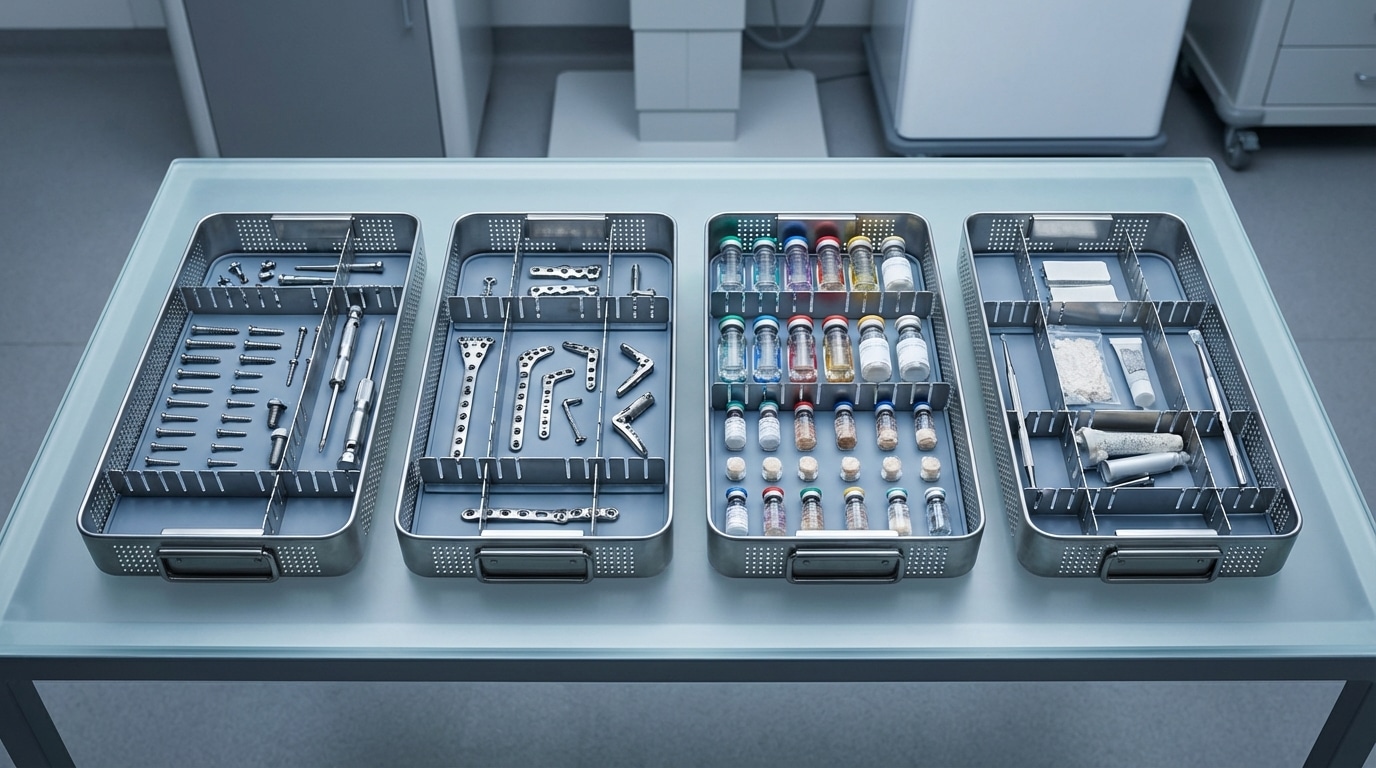
- Biologics. Bone graft, amniotic tissue, PRP kits, skin substitutes. These products are used alongside hardware in most orthopedic and spine procedures. Adding a biologics line to an existing hardware territory is the single highest-ROI product decision most independent reps can make. The incremental time is minimal. The incremental revenue is significant.
- Complementary hardware. If your anchor is spine, adding a trauma line gives you access to a different case type at the same facilities with the same OR staff. If your anchor is trauma, adding a spine line works the same way in reverse.
- Sports medicine instruments. Arthroscopy anchors, shavers, fluid management, and disposable instruments for sports medicine cases. This expands your reach to a different surgeon subspecialty (sports medicine vs. arthroplasty vs. spine) while keeping you in the same OR suites.
- Power tools and surgical accessories. Drill systems, saw blades, pulse lavage, surgical prep products. Lower margin per unit but high volume and broad applicability across case types.
What Not to Add
Resist the temptation to add product lines that do not connect to your core territory:
- Products for a surgical specialty you do not cover. If you are an orthopedic rep, adding a cardiovascular device line because the commission rate is attractive puts you in ORs where you have no relationships, no clinical knowledge, and no credibility. Stay in your lane until your lane is fully monetized.
- Products with significant case coverage requirements in a different geography. If covering this product line requires you to drive two hours to a facility outside your core territory, the time cost eats the commission. Proximity matters.
- Products from a distributor you do not trust. If the inventory availability or support from distributor B is questionable, do not add their product line just because the commission rate is higher than distributor A. A great rate on a product that does not show up is worth zero.
- Too many lines at once. Every product line requires learning the instrumentation, understanding the surgical technique, managing additional inventory, and maintaining relationships with another distributor or manufacturer. There is a cognitive and logistical limit. Three to five active product lines is manageable for a solo rep. More than that and quality suffers across all of them.
When to Drop a Product Line
Not every product line works out. The decision to drop one is just as important as the decision to add one. Cut a product line when:
- Case volume has not materialized after 6-9 months of active selling. You gave it a fair effort. Surgeons are not adopting. The demand is not there. Move on.
- Product quality issues are recurring. Instrument failures, implant inconsistencies, sterility concerns. If the product creates problems in the OR, it damages your reputation with every case. No commission is worth your credibility.
- The distributor support has deteriorated. Late shipments, incomplete sets, slow commission payments, unresponsive operations team. The product line is only as good as the distributor behind it.
- A better option becomes available. Markets change. New products launch. Better distributor partnerships emerge. Loyalty to a product line that is no longer your best option is expensive sentimentality. Run the numbers. Make the switch if the economics justify it.
- The effective hourly rate has dropped below your threshold. Track this continuously. If a product line’s effective hourly rate falls significantly below your other lines due to pricing pressure, increased competition, or declining case volume, your time is better spent on higher-value products.
Reading Surgeon Demand Signals
The best product line decisions are not made from spreadsheets. They are made from listening to what is happening in the OR and in surgeon conversations. Here are the demand signals that should trigger a product evaluation:
“Do you carry…?” When a surgeon asks if you can source a specific product, that is a direct demand signal. Even if you do not carry it today, document the request. If multiple surgeons ask for the same product category, that is a market signal you should act on.
Surgeon frustration with current products. Complaints about instrument design, implant sizing, product availability, or vendor service are openings. They tell you exactly what the surgeon wants that they are not getting. Find a product that solves that specific frustration.
New procedure adoption. When a surgeon starts performing a new procedure type — adding lateral interbody fusion to their spine practice, for example — they need new instrumentation. Being the rep who shows up with the right product at the right moment cements a relationship.
Facility expansion. A hospital adding an orthopedic service line. An ASC opening a new OR suite. A practice group hiring a new surgeon. Expansion creates demand for new device vendor relationships. Be present for these inflection points.
Competitor rep departure. When a competitor’s rep leaves the territory, their surgeons still need case coverage and product. This is a time-sensitive opportunity. The window closes when the competitor assigns a replacement.
The Portfolio Review Cycle
Do not set your product portfolio and forget it. Review quarterly:
- Which product lines generated the most commission this quarter?
- Which product lines consumed the most time relative to their revenue?
- What surgeon requests have you received that you could not fulfill?
- Are there new products or distributor partnerships worth evaluating?
- Has any product line’s competitive position weakened?
This review takes an hour. It keeps your portfolio optimized and prevents the slow drift toward carrying products out of habit rather than economic logic.
For more on the W-2 vs. 1099 decision and how product line freedom factors into the choice, read our breakdown of 1099 vs. W-2 medical device sales.
Frequently Asked Questions
How many product lines should an independent medical device rep carry?
Three to five active product lines is the productive range for a solo independent rep. One anchor line (typically hardware) provides the foundation. Two to four complement lines (biologics, secondary hardware, sports medicine, surgical accessories) build revenue per case and per surgeon. More than five lines becomes difficult to manage from a clinical knowledge, inventory, and relationship perspective. Quality of coverage declines when you spread across too many products.
Can I carry products from competing manufacturers?
Check your distributor agreements. Most contracts include exclusivity clauses that prevent you from carrying directly competing products — for example, two different pedicle screw systems from two different manufacturers. However, carrying complementary products from different sources is standard practice. A spine hardware line from one distributor and a biologics line from another is common and typically non-conflicting. The key is transparency with all parties and clear delineation of which products go to which accounts.
How do I evaluate a product line I have no clinical experience with?
Start with training. Any distributor or manufacturer offering a product line to independent reps should provide clinical training before you cover your first case. This typically includes instrument system education, surgical technique review (often via cadaver lab), and in some cases, observation of a case covered by an experienced rep. If the distributor does not offer training, that is a disqualifying factor. You should not stand in an OR with a product you do not know cold. Beyond training, talk to other reps who carry the line and surgeons who have used it. Their firsthand experience is more valuable than any product brochure.
What is the best first product line for a new independent rep?
The best first product line is the one closest to your existing clinical experience and surgeon relationships. If you spent three years as a W-2 spine rep, your first independent line should be spine hardware — you already know the instrumentation, the surgical techniques, and the surgeons. Starting with a product category where you have zero clinical background adds months of learning time before you can generate revenue. Match your first line to your strongest existing competency, then diversify from that base.