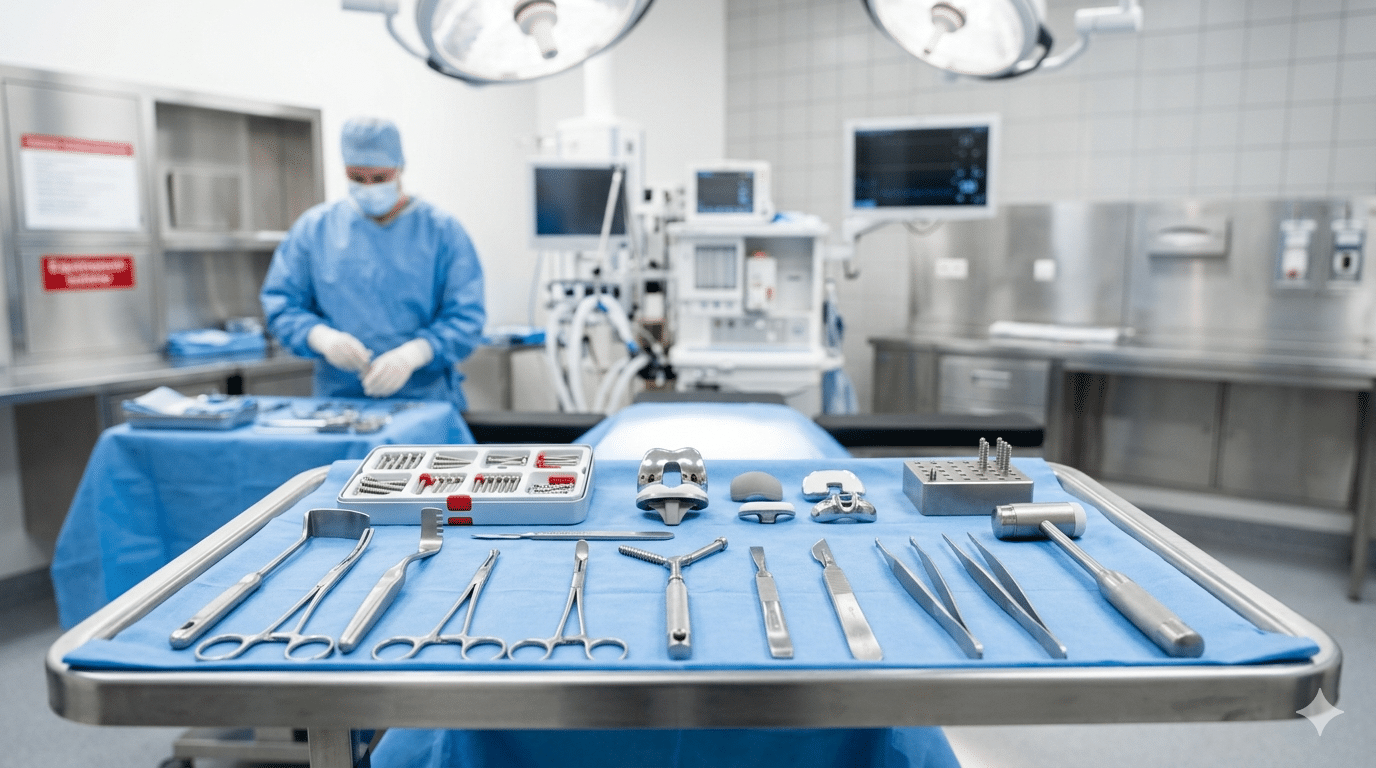
The Complete Guide to Medical Device Sales in 2026
Medical device sales is the business of selling surgical instruments, implants, biologics, and diagnostic equipment to hospitals, ambulatory surgery centers (ASCs), and physician offices. It is one of the highest-paying sales careers in the United States — and one of the most misunderstood. Reps in this field don’t just move product. They stand in operating rooms, advise surgeons on implant selection, manage complex supply chains, and build relationships that determine which devices get used in thousands of procedures every year.
This guide covers everything you need to know about medical device sales in 2026: what the job actually looks like, how the money works, how to break in, and where the industry is heading. Whether you’re considering your first role, evaluating a switch from pharmaceutical sales, or exploring independent distribution as a 1099 rep, this is the reference you’ll keep coming back to.
What Is Medical Device Sales and Why It Pays What It Pays
Medical device sales sits at the intersection of healthcare, engineering, and high-stakes commerce. Unlike pharmaceutical reps who leave samples and brochures, device reps are often in the room when their products are being used — sometimes handing instruments to a surgeon mid-procedure. The job demands clinical knowledge, technical fluency, logistical precision, and the ability to build trust with people who hold lives in their hands.
That combination is why the pay is high. You’re not being compensated for charm or call volume. You’re being paid because the role requires someone who can:
- Understand surgical procedures at a technical level
- Manage inventory worth hundreds of thousands of dollars across multiple facilities
- Respond to emergencies — a surgeon needs a specific plate or screw at 2 a.m., and you make it happen
- Maintain relationships with surgeons, OR directors, materials managers, and hospital administrators simultaneously
- Stay current on FDA clearances, product updates, and competitive offerings
The barrier to entry is real, and that’s by design. Hospitals and surgery centers don’t hand OR access to people who haven’t proven they belong there. This selectivity protects patients and keeps compensation elevated for reps who do the work.
It’s also a career where your ceiling is largely self-imposed. A rep covering a single territory selling commodity products might earn $80,000. A rep who builds a multi-line portfolio across orthopedics, spine, and biologics in a high-volume market can clear $400,000 or more. The spread is enormous, and it’s driven by specialization, territory, hustle, and — critically — the business model you operate under.
Medical Device Market Size and Growth in 2026
The numbers behind this industry explain why it continues to attract top sales talent from every adjacent field.
According to Fortune Business Insights, the global medical device market was valued at approximately $595 billion in 2024 and is projected to exceed $890 billion by 2032, growing at a compound annual growth rate (CAGR) of around 5.9%. The U.S. remains the single largest market, accounting for roughly 40% of global device revenue.
Several forces are driving this growth:
- Aging population. According to the U.S. Bureau of Labor Statistics, the 65-and-older demographic is the fastest-growing segment of the population. More aging joints, more spinal degeneration, more surgical intervention. Orthopedic and spine device demand tracks directly with this demographic shift.
- ASC expansion. Ambulatory surgery centers are performing procedures that were hospital-exclusive five years ago. Total joint replacements, multi-level spine fusions, complex arthroscopic repairs — all migrating to outpatient settings. Every new ASC needs device suppliers, and they often prefer smaller, more responsive distributors over the legacy OEMs.
- Biologics growth. The biologics segment — amniotic tissue, bone grafts, PRP systems, cellular therapies — is expanding faster than traditional hardware. Surgeons are increasingly incorporating biologics into procedures that previously relied on hardware alone.
- Emerging markets and procedure volume increases. Minimally invasive surgery, robotic-assisted procedures, and improved implant longevity are expanding the addressable patient population. Procedures that were too risky or too invasive for certain patients five years ago are now routine.
For sales professionals, the practical takeaway is this: the pie is getting bigger, and the slices are shifting. Reps who position themselves in growth segments — biologics, ASC supply, sports medicine, and specialized orthopedic hardware — are riding tailwinds. Reps locked into commodity products at legacy OEMs with shrinking margins are fighting headwinds.
Types of Medical Devices You Can Sell
Not all medical device sales roles are created equal. The device category you sell determines your daily routine, your earning potential, your call points, and how deeply embedded you become in clinical workflows.
Orthopedic Implants and Hardware
This is the backbone of surgical device sales. Orthopedic hardware includes bone screws, plates, intramedullary nails, total joint replacement systems (hip, knee, shoulder), and trauma fixation devices. Reps in this space cover operating rooms for fracture repairs, joint replacements, and reconstructive procedures. You need to know anatomy, understand surgical approaches, and be able to locate and hand off the correct implant or instrument from a multi-tray system under time pressure.
Spine Devices
Spine is often considered the pinnacle of medical device sales — and the most demanding. Products include pedicle screws, interbody cages, cervical plates, artificial discs, and spinal cord stimulators. Cases are long, anatomically complex, and high-risk. Reps are frequently scrubbed into procedures, standing at the surgeon’s side for hours.
Biologics and Regenerative Products
Biologics represent one of the fastest-growing segments in medical device sales. Products include amniotic membrane allografts (such as AmnioFix), demineralized bone matrices, synthetic bone graft substitutes, platelet-rich plasma (PRP) preparation systems, and cellular tissue products. These are used across orthopedics, spine, wound care, and sports medicine.
Sports Medicine Instrumentation
Sports medicine encompasses arthroscopic instruments, suture anchors, interference screws, meniscal repair devices, and soft-tissue fixation systems. The procedures — ACL reconstructions, rotator cuff repairs, labral repairs, meniscectomies — are high-volume and increasingly performed in ASCs.
Capital Equipment and Robotics
Surgical robots, imaging systems, powered instruments, and operating room infrastructure. These are big-ticket, long sales cycles — often six to eighteen months from first conversation to purchase order.
Wound Care and Soft-Tissue Products
Skin substitutes, negative pressure wound therapy systems, advanced dressings, and tissue matrices used in chronic wound management, burns, and surgical reconstruction. This segment has lower barriers to entry than orthopedics or spine and can serve as a solid entry point for new reps.
| Category | Typical Call Point | Case Involvement | Avg. Rep Earnings | Entry Difficulty |
|---|---|---|---|---|
| Orthopedic Implants | Hospital OR, ASC | High — in the room | $150K-$350K+ | High |
| Spine Devices | Hospital OR | Very High — scrubbed in | $200K-$500K+ | Very High |
| Biologics | OR, Clinic, ASC | Moderate | $120K-$300K+ | Moderate |
| Sports Medicine | ASC, Hospital OR | High | $130K-$300K+ | Moderate-High |
| Capital Equipment | Hospital Admin, OR | Low — post-install training | $120K-$400K+ | High |
| Wound Care | Clinic, Hospital Floor | Low-Moderate | $80K-$180K | Low-Moderate |
Medical Device Sales Career Paths: W2 vs. 1099
This is the decision most reps don’t fully understand until they’ve been in the industry for a few years — and by then, they’ve often locked themselves into one path without realizing the other existed.
W2 Employee (Direct Hire)
You’re hired by a manufacturer — Stryker, DePuy Synthes, Zimmer Biomet, Smith+Nephew, Medtronic, Arthrex — as a salaried employee with benefits. You sell that company’s product line exclusively.
Advantages: Base salary provides income stability. Benefits: health insurance, 401(k), car allowance. Structured training programs. Brand recognition opens doors. Clear career progression.
Disadvantages: Income ceiling — your commission plan is designed to cap your upside. No equity in your book. Product limitations. Corporate overhead.
1099 Independent Rep / Distributor
You operate as your own business entity, contracting with one or more manufacturers or distributors to represent their product lines.
Advantages: Higher commission rates. Multi-line capability. You own your relationships. Tax advantages. No quota resets. Unlimited earning ceiling.
Disadvantages: No base salary. You pay for your own benefits. Credentialing can be harder. Steeper learning curve without corporate training.
| Factor | W2 Employee | 1099 Independent |
|---|---|---|
| Base Salary | Yes ($60K-$100K typical) | No |
| Commission Rate | Lower (company absorbs overhead) | Higher (you absorb overhead) |
| Product Lines | Single manufacturer | Multiple — your choice |
| Income Ceiling | Capped by plan design | Uncapped |
| Book of Business | Belongs to company | Belongs to you |
| Training | Structured, formal | Self-directed or distributor-provided |
| Territory Control | Assigned, can be split | You define it |
| Career Equity | Limited | High — you’re building your own business |
The pattern in the industry is clear: many of the highest-earning reps spent their first 2-5 years at a major OEM learning the clinical side, building surgeon relationships, and getting trained — then transitioned to independent distribution where they could carry multiple lines, own their accounts, and remove the income ceiling.
Medical Device Sales Salary and Compensation Breakdown
Entry Level (0-2 Years): Associate Sales Rep
- Base salary: $55,000-$75,000
- Commission/bonus: $15,000-$40,000
- Total compensation: $70,000-$115,000
Mid-Level (2-5 Years): Full-Line Sales Rep
- Base salary: $70,000-$100,000
- Commission: $50,000-$150,000
- Total compensation: $120,000-$250,000
Senior / Independent Level (5+ Years)
- W2 senior rep total comp: $200,000-$350,000
- 1099 independent rep/distributor: $200,000-$500,000+ (some exceed $750,000)
According to the Bureau of Labor Statistics, the median annual wage for wholesale and manufacturing sales representatives was approximately $73,080 as of their most recent data. But that figure is misleading for medical devices specifically — it includes reps selling commodity industrial products. Within surgical device sales, median compensation runs significantly higher.
What Drives Compensation Differences
- Product category. Spine and complex orthopedics pay the most.
- Territory volume. A territory with three high-volume joint replacement surgeons is worth more than ten low-volume surgeons.
- Business model. 1099 reps earn higher percentages and have no ceiling.
- Multi-line vs. single-line. Carrying complementary lines means you earn on multiple products per case.
- Surgeon loyalty. Reps who become indispensable build books that are nearly impossible for competitors to crack.
How to Break Into Medical Device Sales
Background That Gets You Hired
- B2B sales experience. If you’ve carried a quota and sold to businesses, the clinical knowledge can be taught.
- Collegiate or professional athletics. Former athletes understand preparation, competition, and performance under pressure.
- Clinical background. Surgical techs, physician assistants, nurses, and athletic trainers who want higher earning potential.
- Pharmaceutical sales. The relationship-building fundamentals transfer.
- Military veterans. Discipline, composure under pressure, and comfort with complex protocols.
Concrete Steps to Get Your First Role
- Start with B2B sales if you have no sales background. Two years of strong results makes you a viable candidate.
- Get your foot in the door through adjacent roles. Associate rep positions and clinical support roles get you OR exposure.
- Network with purpose. Attend AAOS, NASS, and regional surgical society meetings. Connect with reps on LinkedIn.
- Consider the independent distributor route. Established distributors actively recruit 1099 reps and provide product lines, training, and logistical support.
- Get credentialed early. Complete vendor credentialing through Reptrax, Vendormate, or GHX.
What a Day in Medical Device Sales Actually Looks Like
Morning: 5:30 AM – 8:00 AM
Your first case is at 7:30 AM. You’re at the surgery center by 6:15 to check in, verify your instrument trays and implant inventory, and confirm case details with the OR staff.
Mid-Morning: 8:00 AM – 12:00 PM
You’re in the operating room. For a total hip replacement, that means standing at the surgeon’s side for 60-90 minutes, presenting instruments in the correct sequence, confirming implant sizes, opening sterile packaging, and being ready to troubleshoot.
Afternoon: 12:00 PM – 4:00 PM
Lunch with a surgeon. Process purchase orders. Update inventory tracking. Follow up on outstanding payments. Prepare implant kits for tomorrow’s cases.
Late Afternoon/Evening: 4:00 PM – 7:00 PM
A trauma call comes in. A distal femur fracture needs ORIF tonight. You drive to the hospital, deliver the trauma plating system, and stand by for intraoperative support. This isn’t every day. But it’s enough days that you understand: this career demands flexibility and clinical preparedness.
Skills That Separate Top Medical Device Sales Reps
Clinical Fluency
Not clinical expertise — that belongs to the surgeon. But fluency. The ability to speak the language, understand the anatomy, anticipate the steps of a procedure, and contribute meaningfully to implant selection discussions.
Inventory and Logistics Mastery
Knowing where every tray, every implant, and every instrument is at all times. Making sure that a surgeon never — not once — looks up in the middle of a case and finds that what they need isn’t there. Zero-lead-time delivery from stocked warehouses is a significant competitive advantage.
Relationship Depth Over Breadth
Top reps go deep with fewer accounts rather than trying to cover as many as possible. Depth of relationship creates switching costs that protect your business.
Business Acumen
Understanding how value analysis committees evaluate products, how GPO contracts work, and what drives ASC purchasing decisions.
Problem-Solving Under Pressure
Things go wrong in the OR. A screw strips. An implant doesn’t fit. A planned procedure changes mid-case. Your value is determined by your ability to solve the problem calmly, quickly, and correctly.
FDA Regulations and Compliance Every Rep Must Know
Device Classification
The FDA classifies medical devices into three categories:
- Class I: Low-risk devices (bandages, tongue depressors). Minimal regulatory control.
- Class II: Moderate-risk devices (surgical instruments, many orthopedic implants). Require 510(k) premarket notification.
- Class III: High-risk devices (spinal cord stimulators, total joint systems). Require Premarket Approval (PMA).
AdvaMed Code of Ethics
Governs interactions between device companies and healthcare professionals. Key provisions: meals must be modest and tied to informational presentations, no gifts, consulting arrangements must be for legitimate services at fair market value.
Sunshine Act / Open Payments
Requires manufacturers to report any payment or transfer of value exceeding $10 to a physician or teaching hospital. As a rep, you need to track every meal, every educational event, and every consulting payment.
The Future of Medical Device Sales: Trends Reshaping the Industry
The Shift to Ambulatory Surgery Centers
The single biggest structural shift. Procedures are migrating out of hospitals and into ASCs. Independent reps and smaller distributors have a natural advantage in the ASC environment — they’re faster, more flexible, and better at high-touch service.
AI and Digital Tools in Sales Workflows
AI is entering as a force multiplier — predictive analytics for territory planning, automated inventory tracking, CRM insights. The core of the job — standing in an OR, earning trust, solving problems — remains irreplaceable by technology.
Value-Based Care and Bundled Payments
The conversation is shifting from “this implant costs X” to “this implant costs X and delivers Y outcomes, resulting in Z total savings.”
Biologics Integration
Biologics are becoming standard adjuncts in procedures that were previously hardware-only. Reps who carry both hardware and biologics capture more revenue per case.
Supply Chain Resilience
A growing preference for distributors that maintain fully stocked warehouses with zero-lead-time processing. Being able to deliver what a surgeon needs, when they need it, without a three-week backorder — that’s a genuine differentiator.
Frequently Asked Questions About Medical Device Sales
What is the average salary for medical device sales reps?
Total compensation ranges from $70,000 to $500,000+ depending on experience, product category, territory, and business model. Entry-level reps earn $70,000-$115,000. Mid-level reps earn $120,000-$250,000. Senior reps and independent distributors in orthopedics and spine frequently exceed $300,000.
Do you need a degree to work in medical device sales?
A four-year degree is strongly preferred by major manufacturers but not an absolute requirement, especially in independent distribution. Results, personality, and work ethic matter more than your GPA.
What is the difference between a 1099 and W2 medical device sales rep?
A W2 rep is a direct employee receiving salary, benefits, and commission while selling one company’s products. A 1099 rep is an independent contractor representing multiple product lines, earning higher commissions but covering their own expenses and benefits.
How long does it take to break into medical device sales?
For someone with no prior experience, typically 1-3 years. This usually involves building B2B sales experience first, then securing an associate rep or clinical support role. Direct entry through an established distributor can be faster — sometimes months — but the ramp-up before meaningful commissions takes 6-12 months.
What are the best medical device companies to work for?
For W2 positions, the major orthopedic OEMs — Stryker, DePuy Synthes, Zimmer Biomet, Smith+Nephew, Arthrex — are widely regarded as top employers. However, if you prioritize earning potential, autonomy, and ownership, working with an established independent distributor may be a better fit.
Is medical device sales a good career in 2026?
Yes. The market continues to grow, driven by demographic trends, procedural volume increases, and ASC expansion. Demand for skilled reps remains strong because the role requires a combination of clinical knowledge, sales ability, and operational competence that is difficult to automate.
Getting Started With SLR Medical Consulting
SLR Medical Consulting has spent over a decade building exactly the kind of infrastructure that independent reps need to compete — and win. The company supplies thousands of surgical facilities nationwide with orthopedic hardware, biologics (including AmnioFix), sports medicine instrumentation, and spine devices. Every product ships with zero-lead-time processing from fully stocked warehouses.
That last point matters more than it sounds. When a surgeon adds a case at 4 PM on Thursday for Friday morning, and they need a specific plating system, the distributor who delivers that night gets the case. Speed and reliability compound into surgeon loyalty over hundreds of cases.
SLR actively recruits independent 1099 sales reps and distribution partners. If you’re an experienced rep looking to go independent, or an aspiring rep with the right background who’s ready to build their own business, SLR provides the product portfolio, the inventory infrastructure, and the operational support to make that transition viable.
Explore distribution opportunities with SLR Medical Consulting: Learn about Distribution Opportunities | View Consulting Opportunities
This guide is part of SLR Medical Consulting’s medical device sales career resource center. In-depth articles on orthopedic device sales, building a biologics territory, transitioning from W2 to independent distribution, and surgeon relationship management are coming soon. Bookmark this page as the series expands.