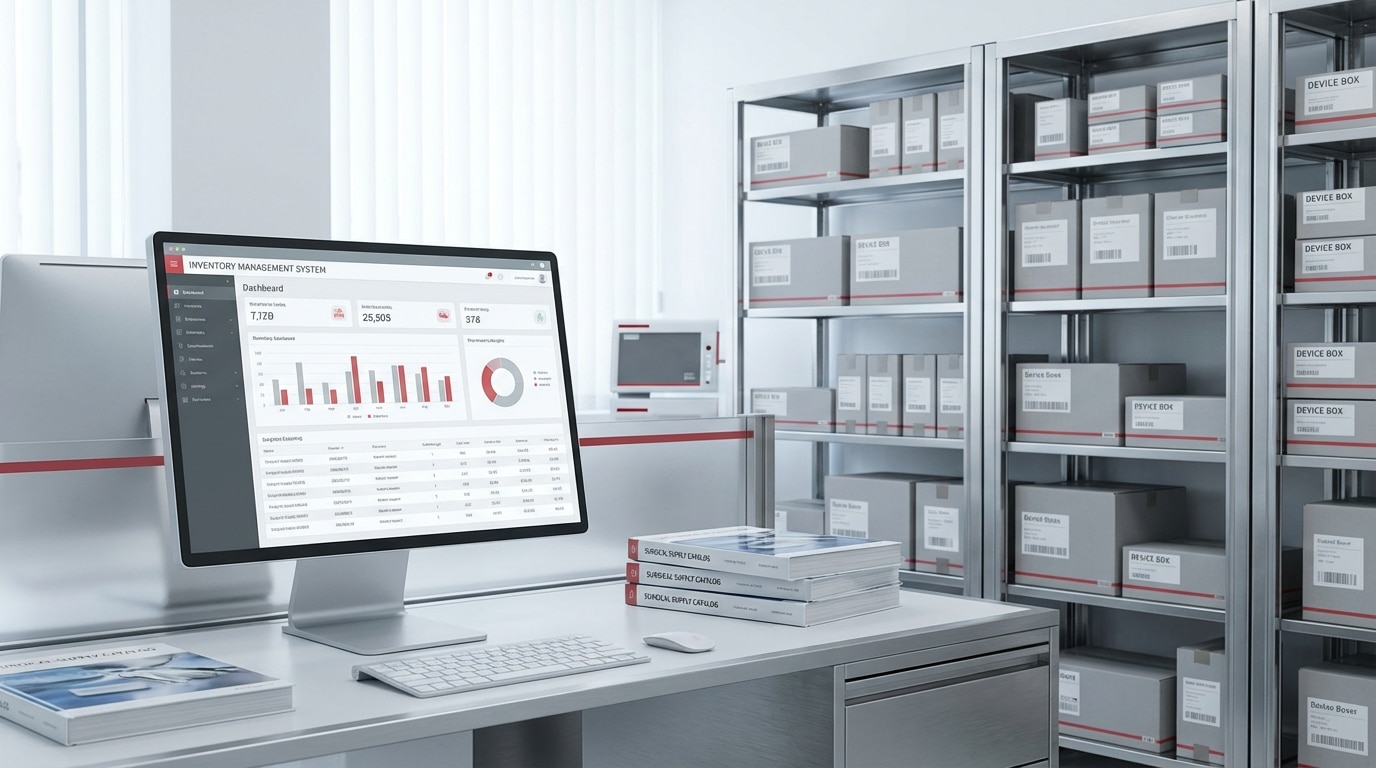
Choosing the Right Orthopedic Device Supplier for Your Facility
Choosing an orthopedic device supplier is not a purchasing decision. It is an operational decision that determines whether your surgical schedule runs or stalls. The wrong supplier does not just cost more per implant — it cancels cases, frustrates surgeons, creates compliance exposure, and quietly drains revenue from your facility every week it underperforms.
Most surgical facilities evaluate suppliers on price first. That is a mistake. The most expensive implant failure is not a high unit cost — it is a case cancellation because the tray set did not arrive, a reoperation because the hardware was substandard, or a compliance finding because documentation was missing. Price matters, but it is the fourth or fifth thing that matters, not the first.
This guide covers the evaluation criteria that actually predict whether an orthopedic device supplier will perform for your facility: inventory and lead time, product breadth, field support, regulatory compliance, pricing structure, and partnership stability. It is written for procurement directors, materials managers, OR directors, and administrators at hospitals and ambulatory surgery centers.
Inventory Availability and Lead Time
This is the single most consequential variable in supplier selection. Everything else is secondary to the question: When I need hardware for a case, will it be here?
Orthopedic surgery is not a just-in-time manufacturing operation. Fractures do not schedule themselves. Elective joint replacements are booked on surgical calendars that do not wait for backorders to clear. Spine cases require specific screw diameters, rod lengths, and cage sizes matched to preoperative imaging — and the booking-to-surgery window can be 48 hours or less.
There are three inventory models in orthopedic device distribution, and they produce very different outcomes for your facility:
Consignment Inventory
The supplier places a defined set of implants at your facility, and you are billed only when an implant is used. This model guarantees availability for stocked sizes and types, but it has limitations. Consignment sets are finite — they do not cover every size, and when a case requires a non-stocked size, you are back to ordering with lead time. Consignment also ties up the supplier’s capital, which means smaller suppliers may limit the depth or breadth of consignment sets. And there is always the reconciliation overhead — counting, tracking, replenishing, and auditing consignment inventory is an ongoing operational cost for your materials management team.
Loaner/Delivery Model
The supplier ships a complete tray set to your facility before each case. This is the standard model for most major orthopedic manufacturers. It works when the supplier’s distribution infrastructure is strong and lead times are reliably short. It fails when distribution centers are distant, when demand spikes create allocation problems, or when the logistics chain has any single point of failure. A snowstorm in Memphis can cancel a knee replacement in Nashville if the tray set is in transit through a FedEx hub.
Fully Stocked Warehouse / Zero-Lead-Time Model
The supplier maintains deep inventory in regional or national warehouses and processes orders with zero lead time — meaning the hardware ships the same day or next day, with complete tray sets available without advance booking. This model eliminates the scheduling dependency between your surgical calendar and the supplier’s logistics. It is the most operationally resilient model, particularly for facilities with high case volumes, short booking windows, or trauma programs where case timing is unpredictable.
When evaluating any prospective supplier, ask this question directly: If I book a proximal femur fracture case for tomorrow morning at 7 AM, what time does the complete tray set arrive at my facility? If the answer involves the words “we’ll check availability” or “depends on the distribution center,” keep looking.
Product Portfolio Breadth
A surgical facility doing orthopedic trauma, joint replacement, spine, and sports medicine needs hardware across all four categories. Sourcing each category from a different supplier means four separate vendor credentials, four sets of tray management logistics, four invoice streams, four rep relationships, and four sets of contract terms to manage.
Portfolio breadth matters for three reasons:
- Operational simplification — fewer vendors means less credentialing, less tray management, less invoice processing, and simpler inventory reconciliation.
- Cross-system compatibility — when screws, plates, and instruments come from the same manufacturer, compatibility is guaranteed. Cross-manufacturer hardware use creates liability exposure and technical risk (different thread pitches, incompatible locking mechanisms, mismatched metallurgy).
- Purchasing power — consolidating volume with fewer suppliers typically produces better per-unit pricing and stronger contract terms than fragmented spend across many vendors.
Evaluate whether the supplier covers your primary surgical categories. For most orthopedic-focused facilities, this means:
- Fracture fixation hardware (screws, plates, nails, external fixation)
- Joint replacement implants (hip, knee, shoulder)
- Spine instrumentation (pedicle screws, cages, cervical plates, biologics)
- Sports medicine (anchors, interference screws, ACL/rotator cuff instrumentation)
- Biologics (bone graft substitutes, DBM, cellular allografts, amniotic tissue)
No single supplier covers every product in every category. But a supplier that covers three or four of these categories from a single source eliminates significant logistical friction. For a detailed look at the orthopedic product categories and what to look for, see our orthopedic surgical implants guide.
Field Support and Case Coverage
Orthopedic cases require a knowledgeable device representative or technical specialist in the operating room. This person is not a salesperson during the case — they are an operational asset. They manage the instrumentation trays, ensure the correct implant sizes are available on the back table, troubleshoot instrument issues, and provide technical guidance on implant selection and technique when the surgeon asks for it.
The quality of field support varies dramatically between suppliers. Here is what separates good field support from inadequate field support:
Good Field Support
- The rep knows the instrument sets cold — every tray, every instrument, every assembly sequence
- The rep understands the surgical technique and can anticipate the surgeon’s next step
- Tray sets arrive complete, organized, and sterilized. Missing instruments are caught before the case, not during it
- The rep is physically present for case coverage and available for scheduling changes
- Post-case documentation (implant usage, lot numbers, device tracking) is handled by the rep, not dumped on the OR staff
Inadequate Field Support
- The rep does not know the instrumentation and reads the technique guide during the case
- Tray sets arrive with missing or incorrect instruments
- The rep is unavailable for add-on cases or schedule changes
- Post-case documentation is incomplete or delayed
- Case coverage is handled by rotating reps who do not have a consistent relationship with the surgical team
During supplier evaluation, request references from facilities the supplier currently covers. Ask the OR director or surgical technologists — not the administrator — about the quality of case coverage. The people in the room know whether the rep is an asset or a liability.
Regulatory Compliance and Documentation
Every orthopedic implant used in your facility must be FDA-cleared (510(k) or PMA), properly labeled, traceable by lot or serial number, and documented in the patient’s record. The supplier is your compliance partner in this chain — they must provide:
- 510(k) clearance letters for every device they supply
- Certificates of Conformity confirming manufacturing under an FDA-registered quality system (21 CFR 820)
- Device labeling per FDA 21 CFR 801, including UDI (Unique Device Identification) compliance
- Lot traceability — the ability to trace any implant from the patient back to the manufacturing lot and raw material
- Recall and field safety notice communication — timely notification if any supplied device is subject to a recall or safety alert
- Implant usage documentation — stickers, electronic records, or scanning systems that capture what was implanted in each patient
A supplier that cannot produce 510(k) clearance documentation for every product in their catalog on request is a compliance risk your facility cannot afford. During evaluation, request the regulatory file for a sample of products. If the response is slow, incomplete, or evasive, treat that as disqualifying.
For facilities pursuing Joint Commission accreditation or CMS Conditions of Participation compliance, implant traceability is not optional. Your supplier must support your documentation requirements without creating additional administrative burden on your OR staff.
Pricing Models and Contracting
Orthopedic implant pricing has historically been opaque, and it still is at many suppliers. The same hip stem can vary by 40-60% in price depending on the facility, the contract, the GPO affiliation, and the negotiation. Understanding the pricing models helps you negotiate from a position of knowledge rather than dependence.
GPO Contracts
Group Purchasing Organizations (Vizient, Premier, HealthTrust, Intalere) negotiate volume-based contracts with device manufacturers on behalf of member facilities. GPO pricing is typically the baseline — not the floor. Facilities with high volume or strategic value can negotiate below GPO pricing through direct agreements.
Direct Agreements
A direct contract between the facility and supplier, often negotiated outside the GPO framework. These can produce lower per-unit pricing in exchange for volume commitments, product standardization (using one manufacturer’s products exclusively), or multi-year terms.
ASC-Specific Pricing
Ambulatory surgery centers operate under different reimbursement structures than hospitals (often bundled payments or fixed facility fees), which compresses implant budgets. Many suppliers offer ASC-specific pricing tiers that reflect this reality. If you are an ASC, ask specifically for ASC pricing rather than accepting hospital-tier pricing.
What to Negotiate
- Per-implant pricing with a complete price list — no hidden charges for trays, instruments, or loaner set processing
- Volume tiers with automatic price reductions as usage increases
- Cap pricing for joint replacement cases — a maximum per-case implant cost regardless of the specific components used
- Consignment terms — no consignment fees, clear replenishment timelines, and defined reconciliation processes
- Payment terms — Net 30 is standard, but Net 45 or Net 60 may be negotiable for larger facilities
Get pricing in writing with a complete catalog. A supplier that quotes selectively — providing pricing on their most competitive items while leaving other products unquoted — is managing your perception, not your costs.
Special Considerations for ASCs
Ambulatory surgery centers have specific supplier requirements that differ from hospital procurement:
- Storage constraints — ASCs typically have limited sterile storage. Consignment models that require dedicated shelf space may not be practical. A delivery model with reliable same-day or next-day tray availability may be a better fit.
- Bundled reimbursement pressure — ASC reimbursement for joint replacement and spine cases is often bundled, meaning the implant cost directly reduces the facility’s margin. Implant cost as a percentage of reimbursement is a critical metric. Suppliers who understand ASC economics and price accordingly are better partners than those applying hospital pricing models.
- Credentialing simplicity — ASCs often have leaner administrative teams. A supplier that handles their own credentialing paperwork, maintains current insurance documentation, and does not create administrative overhead is operationally valuable.
- Case scheduling flexibility — ASCs add and move cases frequently. Suppliers must be responsive to schedule changes without penalizing the facility for short-notice tray requests.
Red Flags in Supplier Evaluation
These are the warning signs that predict supplier failure. Any one of them warrants caution. Multiple red flags are disqualifying.
- Vague lead time answers — “We’ll do our best” or “usually within a few days” is not a service level. Demand specific, committed turnaround times.
- Incomplete tray sets during evaluation cases — if the trial period has missing instruments, production service will be worse.
- Rotating field reps with no consistent point of contact for your facility.
- Resistance to providing regulatory documentation — 510(k) letters, quality system certifications, and lot traceability should be immediate, not negotiated.
- No references from comparable facilities — a supplier that cannot provide references from facilities similar to yours (same case types, same volume level) may not have the experience to serve you.
- Aggressive discounting without substance — a dramatically lower price with no clear explanation of how it is achieved should raise questions about product sourcing, quality systems, and long-term viability.
- Poor communication during the evaluation period — response time during courtship is the best-case scenario. It only gets slower after the contract is signed.
Building Your Evaluation Process
A structured supplier evaluation process protects your facility from making decisions on incomplete information. Here is a practical framework:
Step 1: Define Requirements
Document your facility’s needs: product categories, case volume by type, lead time requirements, storage capacity, compliance documentation standards, and budget parameters. This becomes the evaluation scorecard.
Step 2: Request Information
Send a formal RFI (Request for Information) to prospective suppliers covering: product catalog, pricing, inventory model, lead time commitments, field support structure, regulatory documentation, and facility references. Evaluate written responses before investing time in meetings.
Step 3: Conduct Site Visits or Calls
For shortlisted suppliers, conduct a facility visit (or virtual tour of their distribution operation) and meet the team that will support your account. Understand their warehouse operations, inventory management systems, and staffing model.
Step 4: Run Trial Cases
Before committing to a contract, run 3-5 trial cases with the prospective supplier. Evaluate: tray completeness, delivery timing, rep knowledge, instrument quality, post-case documentation, and invoice accuracy. Trial cases reveal operational truth that sales presentations do not.
Step 5: Negotiate and Contract
Negotiate terms based on your evaluation findings. Include service level commitments (lead time guarantees, tray completeness standards, rep availability) in the contract alongside pricing. A contract that only addresses pricing is a purchasing document, not a partnership agreement.
The SLR Medical Consulting Difference
SLR Medical Consulting has been supplying surgical facilities nationwide for over a decade with orthopedic hardware, spine instrumentation, biologics, and sports medicine devices. Our model is built on the two things that matter most: inventory depth and speed.
- Zero-lead-time processing from fully stocked warehouses — your surgical schedule dictates timing, not our supply chain
- Broad product portfolio covering orthopedic trauma, spine, sports medicine, and biologics from a single source
- Full regulatory compliance with complete documentation, lot traceability, and FDA-cleared products
- Field support from knowledgeable representatives who understand the instrumentation and the surgery
Place a surgical order or contact us to start the evaluation process. We are confident in what a trial case will show you.
Frequently Asked Questions About Choosing an Orthopedic Device Supplier
What is the most important factor when evaluating an orthopedic device supplier?
Inventory availability and delivery lead time. A supplier with the lowest per-unit price but unreliable delivery creates far more cost — in cancelled cases, surgeon frustration, patient rescheduling, and lost revenue — than a slightly higher-priced supplier with guaranteed zero-lead-time delivery. Ask every prospective supplier to commit to a specific lead time in writing, and run trial cases to verify that commitment before signing a contract.
Should our facility use one supplier for all orthopedic categories or multiple specialized suppliers?
Consolidation with fewer suppliers is almost always operationally superior. Each additional vendor adds credentialing overhead, tray management complexity, separate invoicing, and additional rep relationships to manage. A single supplier covering trauma, spine, sports medicine, and biologics simplifies procurement and typically produces better pricing through volume consolidation. Use multiple suppliers only when a single source genuinely cannot cover a critical product category or when surgeon preference for a specific product line requires it.
How do we evaluate field support quality before signing a supplier contract?
Run trial cases. There is no substitute for seeing the rep perform in your operating room with your surgical team. During trial cases, evaluate: Does the rep arrive on time with complete, organized tray sets? Do they know the instrumentation without referencing a manual? Can they anticipate the surgeon’s needs during the case? Is post-case documentation (implant stickers, lot tracking, usage reporting) completed accurately and promptly? Ask your OR nurses and surgical techs for candid feedback — they are the most reliable judges of field support quality.
What compliance documentation should we require from every orthopedic device supplier?
At minimum, require: FDA 510(k) clearance letters for every product supplied, evidence of manufacturing under an FDA-registered quality system (21 CFR 820 compliance), ISO 13485 certification, current product liability insurance, complete device labeling with UDI compliance, lot-level traceability for every implant, and a documented process for communicating recalls and field safety notices. These are not negotiable items. A supplier that cannot provide this documentation promptly is a compliance liability.
About SLR Medical Consulting: SLR Medical Consulting has been supplying surgical facilities nationwide for over a decade with orthopedic hardware, spine instrumentation, biologics, and sports medicine devices. Our zero-lead-time delivery model means your surgical schedule runs on your timeline, not your supply chain’s. Explore our hardware catalog or place a surgical order today.