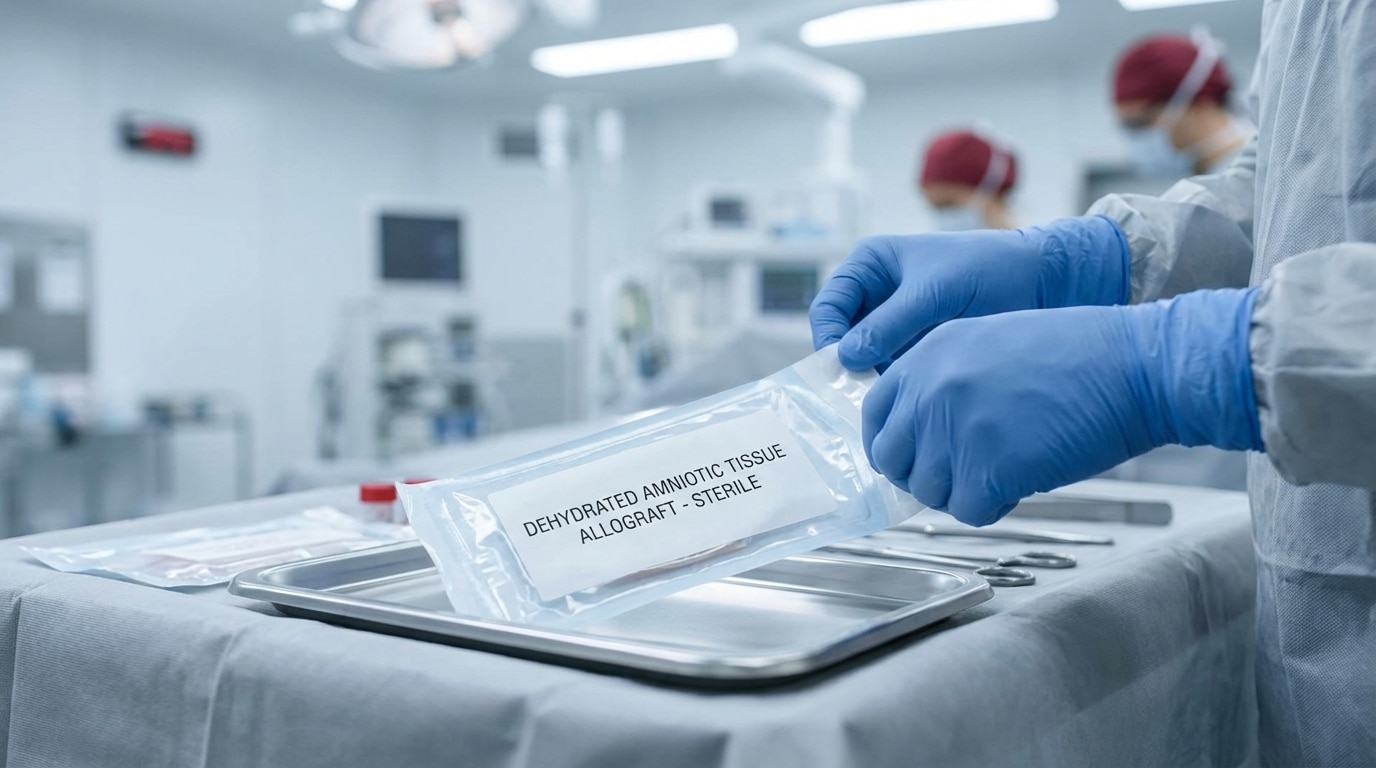
Amniotic Tissue in Surgery: Applications, Benefits, and Evidence
Amniotic tissue has been used in medicine since the early 1900s. Ophthalmologists were placing amniotic membrane on damaged corneas in the 1940s. Burn surgeons were using it as a wound covering decades before any orthopedic surgeon considered it for a rotator cuff repair. The biological properties that made it useful in those fields — anti-inflammatory activity, anti-fibrotic effects, growth factor content, and immunologic privilege — are the same properties that have driven its adoption in musculoskeletal surgery over the past decade.
But the orthopedic and spine applications are newer, the evidence base is still developing, and the market has grown faster than the clinical data in some areas. For surgeons evaluating these products and for device representatives selling them, understanding what amniotic tissue actually does, where the evidence supports its use, and where the science is still catching up to the marketing is essential.
This article covers the biology, the clinical applications, the published evidence, and the practical considerations for amniotic tissue products in orthopedic and spine surgery.
The Biology of Amniotic Tissue
The human amniotic membrane is the innermost layer of the fetal membranes. It lines the amniotic cavity and is in direct contact with the amniotic fluid throughout pregnancy. The placental tissue — including the amnion, chorion, and umbilical cord — is normally discarded after cesarean delivery. Amniotic tissue products are derived from this tissue, donated by consenting mothers after scheduled cesarean sections.
What makes amniotic tissue biologically interesting for surgical applications is its composition:
- Collagen-rich extracellular matrix. The amnion contains types I, III, IV, V, and VI collagen, providing a natural scaffold that supports cell migration and tissue repair.
- Growth factors. Amniotic tissue contains epidermal growth factor (EGF), transforming growth factor-beta (TGF-beta), basic fibroblast growth factor (bFGF), platelet-derived growth factor (PDGF), vascular endothelial growth factor (VEGF), and others. These growth factors play established roles in tissue healing, angiogenesis, and cell proliferation.
- Anti-inflammatory cytokines. The tissue contains interleukin-1 receptor antagonist (IL-1Ra) and tissue inhibitors of metalloproteinases (TIMPs), which help modulate the inflammatory response and reduce scar tissue formation.
- Hyaluronic acid. The amnion is naturally rich in hyaluronic acid, which has lubricating, anti-adhesion, and anti-inflammatory properties.
- Immunologic privilege. Amniotic tissue does not express HLA-A, HLA-B, or HLA-DR antigens on its surface, which means it does not typically provoke an immune rejection response when implanted in a recipient. This property allows it to be used as an allograft without immunosuppression.
The combination of these properties — structural scaffold, growth factors, anti-inflammatory mediators, and immunologic privilege — is what distinguishes amniotic tissue from other biologic products. It is not just a scaffold (like synthetic bone graft substitutes) and not just a growth factor delivery vehicle (like BMP-2). It provides a multi-functional biological environment that supports healing through several simultaneous mechanisms.
Processing and Preservation Methods
How amniotic tissue is processed and preserved directly affects its biological activity and clinical performance. This is one of the most important product-differentiation factors in the market, and it’s an area where not all products are equivalent.
Dehydration
Dehydrated amniotic membrane (dHACM) is produced by removing water from the tissue under controlled conditions. The resulting product is shelf-stable at room temperature with a long shelf life, which is a significant practical advantage for surgical inventory management. The dehydration process preserves the collagen scaffold and retains growth factors, though the quantity and bioactivity of retained growth factors depends on the specific dehydration protocol.
MiMedx’s EpiFix and AmnioFix are the most well-known dehydrated amniotic membrane products. EpiFix is used primarily in wound care (particularly diabetic foot ulcers), while AmnioFix is marketed for musculoskeletal applications.
Cryopreservation
Cryopreserved amniotic tissue is frozen under controlled conditions designed to preserve both the structural integrity of the tissue and the viability of certain cellular components. Cryopreserved products require cold chain storage (frozen or refrigerated) and have a limited shelf life compared to dehydrated products.
The theoretical advantage of cryopreservation is retention of viable cells and higher growth factor bioactivity. However, the clinical significance of cell viability in amniotic tissue products remains debated. The majority of cells in processed amniotic tissue are fibroblasts and epithelial cells, not stem cells, and whether their viability at the time of implantation meaningfully contributes to clinical outcomes is an open question.
Lyophilization (Freeze-Drying)
Lyophilized amniotic tissue products are freeze-dried, providing shelf stability similar to dehydrated products while theoretically preserving more biological activity than heat-based dehydration. Several newer products use lyophilization as their primary preservation method.
Why Processing Matters
The processing method determines what the surgeon is actually implanting. A dehydrated amniotic membrane is primarily a collagen scaffold with retained growth factors. A cryopreserved product may contain some viable cells in addition to the scaffold and growth factors. The clinical significance of this difference has not been definitively established in head-to-head trials, but it drives product positioning and pricing in the market.
Orthopedic Surgery Applications
In orthopedic surgery, amniotic tissue is used in several specific clinical scenarios:
Rotator cuff repair augmentation. Amniotic membrane can be placed over a completed rotator cuff repair as a biological augmentation. The rationale is that the anti-inflammatory and growth factor properties of the tissue will reduce scar formation, promote tendon healing, and potentially reduce retear rates. This is one of the more studied applications in orthopedic surgery, with several prospective trials in progress or recently completed.
Tendon repair reinforcement. Beyond the rotator cuff, amniotic tissue is used to augment Achilles tendon repairs, patellar tendon repairs, and other tendon reconstructions. The tissue acts as a biological wrap around the repair site.
Joint surface applications. Some surgeons use amniotic tissue in the joint environment for cartilage defect coverage, synovitis reduction, and as a biological adjunct to microfracture or other cartilage repair procedures. The anti-inflammatory properties may help modulate the intra-articular environment.
Nerve wrapping. Amniotic membrane has been used as a nerve wrap following neurolysis or nerve repair, based on its anti-adhesion and anti-scarring properties. The goal is to prevent perineural scar formation that can cause recurrent nerve compression.
Surgical site coverage. In revision surgery or cases with compromised soft tissue, amniotic tissue can be applied as a biological wound covering to promote healing and reduce adhesion formation.
Spine Surgery Applications
Amniotic tissue use in spine surgery has grown significantly, driven by two primary applications:
Epidural adhesion prevention. Epidural fibrosis — scar tissue formation around the dura and nerve roots following spinal surgery — is a recognized cause of persistent pain and a complicating factor in revision surgery. Amniotic membrane placed over the dura after decompression aims to reduce epidural scar formation. The anti-adhesion properties of the tissue provide a biological barrier between the dura and the overlying surgical bed.
This application has precedent in other surgical specialties where amniotic tissue has been shown to reduce adhesion formation. In spine, early clinical data is encouraging, though large randomized trials comparing amniotic membrane to existing anti-adhesion barriers (like Adcon-L, which was withdrawn, or gel-based barriers) are limited.
Biologic augmentation of fusion. Some surgeons use amniotic tissue or amniotic fluid products as a biologic adjunct in spinal fusion, combined with other graft materials. The growth factor content and anti-inflammatory properties are the rationale. The evidence for this application is still early-stage, and the contribution of amniotic tissue to fusion biology versus other graft materials used in the same construct is difficult to isolate.
For an in-depth look at biologics in orthopedic surgery, including how amniotic tissue fits within the broader product category, see our biologics overview.
Sports Medicine Applications
The sports medicine market has been an active adopter of amniotic tissue products, particularly in the following areas:
Injection therapy. Injectable amniotic tissue preparations (micronized dehydrated tissue or amniotic fluid) are used for joint injections in osteoarthritis, tendinopathy, and plantar fasciitis. These injections are positioned as an alternative or complement to corticosteroid and hyaluronic acid injections, with the theoretical advantage of providing growth factors and anti-inflammatory mediators rather than just a short-term anti-inflammatory effect.
Arthroscopic applications. During arthroscopic procedures, amniotic tissue can be applied to the joint surface, over rotator cuff repairs visualized arthroscopically, or as a biologic adjunct to meniscal repairs and cartilage procedures.
Tendon and ligament augmentation. In sports medicine procedures involving tendon or ligament repair — ACL reconstruction, patellar tendon repair, hamstring tendon repair — amniotic tissue is used as a biological wrap or augmentation layer at the repair site.
The sports medicine market is particularly price-sensitive relative to spine, which affects product adoption and purchasing dynamics. The per-unit cost of amniotic tissue products needs to be justified against clinical outcomes, and facilities with tight budgets may limit their use to cases where the clinical rationale is strongest.
Clinical Evidence: What the Data Shows
The evidence base for amniotic tissue in musculoskeletal surgery is mixed in both quality and findings. Here is where the published data stands for the major applications:
Wound Healing
The strongest evidence for amniotic tissue products exists in wound care, particularly for chronic diabetic foot ulcers. Multiple randomized controlled trials have demonstrated significantly higher healing rates with dHACM (EpiFix) compared to standard wound care. While this is not an orthopedic application per se, it establishes the biological activity of the product in human tissue healing.
Joint Injections
Several prospective studies have evaluated amniotic tissue injections for knee osteoarthritis, showing improvements in pain scores and function at 3-12 month follow-up. However, most of these studies are small, single-arm (no control group), and manufacturer-sponsored. The placebo response in injection therapy for knee OA is well-documented and significant, which means uncontrolled trials must be interpreted cautiously. Larger randomized, placebo-controlled trials are needed to definitively establish efficacy beyond placebo.
Rotator Cuff Repair
Preliminary data on amniotic tissue augmentation of rotator cuff repairs has shown lower retear rates in augmented repairs compared to historical controls. Prospective randomized trials are underway, and the early results are encouraging. This is one of the most promising musculoskeletal applications, given the known retear rates of 20-40% for large and massive rotator cuff repairs even with modern surgical techniques.
Epidural Application in Spine
Clinical data on amniotic membrane for epidural adhesion prevention is limited to case series and small prospective studies. The results suggest reduced adhesion formation and lower reoperation rates, but the evidence level is insufficient for definitive conclusions. This application has strong biological rationale and clinical face validity, but it needs larger trials.
Plantar Fasciitis
Amniotic tissue injections for plantar fasciitis have shown positive results in several prospective studies, with significant improvements in pain scores at 8-12 week follow-up. This is a relatively low-cost application with a clear clinical endpoint (pain relief), which makes it an accessible entry point for surgeons and clinics interested in incorporating amniotic tissue into their practice.
Products and Market Overview
The amniotic tissue market in orthopedics and spine includes several major product lines:
- MiMedx: AmnioFix (sheet membrane for musculoskeletal applications), EpiFix (wound care), AmnioFix Injectable (micronized amniotic tissue for injection). MiMedx is the market leader in amniotic tissue products by revenue.
- Organogenesis: NuCel (amniotic tissue/fluid product for spine and orthopedic applications), Affinity (fresh amniotic membrane).
- Integra LifeSciences: AmnioExcel (amniotic membrane for soft tissue applications).
- Stryker: Various amniotic tissue products distributed through their biologics portfolio.
- Smith+Nephew: GRAFIX and STRAVIX (cryopreserved placental membrane products).
The market is also populated by smaller, specialized companies producing amniotic tissue products for specific clinical niches. Competition is intense, and product differentiation is often based on processing method, preservation technique, and clinical data rather than fundamental differences in the source tissue.
Regulatory Considerations
The regulatory status of amniotic tissue products is a critical issue for both manufacturers and users. The FDA has been increasing scrutiny of products marketed under the HCT/P (human cells, tissues, and cellular and tissue-based products) regulatory framework.
To qualify as an HCT/P under Section 361, a product must meet four criteria:
- Minimal manipulation. The processing cannot alter the relevant biological characteristics of the tissue.
- Homologous use. The product must be used for the same basic function in the recipient as in the donor.
- No combination with drugs or devices. The product cannot be combined with another article (except for water, crystalloids, or sterilizing, preserving, or storage agents).
- No systemic effect. The product either has no systemic effect or is for autologous use, allogeneic use in a first-degree or second-degree blood relative, or reproductive use.
The “homologous use” criterion is where many orthopedic applications face regulatory questions. The amniotic membrane functions as a barrier and protective layer in its natural state. Using it as a barrier and anti-adhesion agent in surgery is arguably homologous. Using it as an injection therapy for joint pain may or may not meet the homologous use standard, depending on the FDA’s interpretation.
The FDA has issued warning letters to some manufacturers whose products were marketed with claims or in applications that exceeded the HCT/P framework. Companies whose products do not meet the Section 361 criteria must pursue either a Biologics License Application (BLA) or device clearance pathway, which requires significantly more clinical data and regulatory investment.
This regulatory uncertainty is a real business consideration. Surgeons and facilities need to understand the regulatory status of the products they’re using, and sales representatives need to be prepared to discuss it clearly and accurately.
Practical Considerations for Surgeons and Reps
For surgeons evaluating amniotic tissue products:
- Match the product to the application. A dehydrated sheet membrane is appropriate for surface application over a repair or the dura. An injectable micronized product is appropriate for joint injections or tissue augmentation. The form factor matters.
- Evaluate the evidence specific to your indication. A product with strong wound care data does not automatically have strong data for rotator cuff augmentation. Ask for published evidence in your specific clinical application.
- Understand the regulatory classification. Know whether the product you’re using is classified as an HCT/P, a device, or a biologic, and ensure your use falls within the product’s regulatory framework.
- Consider the cost-benefit. Amniotic tissue products add per-case cost. The clinical benefit needs to justify that cost in terms of improved outcomes, reduced complications, or lower reoperation rates.
For device representatives:
- Lead with clinical data, not just biology. The biological rationale for amniotic tissue is compelling, but surgeons want to see clinical outcomes. Have the published literature organized by indication.
- Know the competitive landscape. Multiple companies offer amniotic tissue products. Be able to articulate what differentiates your product — processing method, clinical data, formulation, or cost position.
- Be precise about regulatory claims. Do not make efficacy claims that exceed the product’s regulatory framework. This is both a compliance issue and a credibility issue with surgeons.
Frequently Asked Questions
What is the difference between amniotic membrane and amniotic fluid products?
Amniotic membrane is the physical tissue layer that lines the amniotic cavity, processed into sheet or particulate forms for surgical application. It provides a collagen scaffold along with growth factors and anti-inflammatory mediators embedded in the tissue matrix. Amniotic fluid is the liquid from the amniotic cavity, which contains growth factors, cytokines, and hyaluronic acid in solution. Fluid-based products are typically used as injectables, while membrane products are used as sheet grafts, wraps, or surface applications. Both contain biologically active components, but the delivery mechanism and clinical application differ.
Is amniotic tissue the same as stem cell therapy?
No. While amniotic tissue contains some cells (primarily fibroblasts and epithelial cells), it is not a stem cell product. The biological activity of amniotic tissue in surgical applications is attributed primarily to its growth factor content, collagen scaffold, and anti-inflammatory properties — not to stem cell activity. Marketing that positions amniotic tissue products as “stem cell therapy” is inaccurate and has drawn FDA scrutiny. The therapeutic mechanism is fundamentally different from true stem cell therapies involving culture-expanded mesenchymal stem cells.
How long does amniotic tissue last after implantation?
Amniotic tissue is a biodegradable material that is resorbed by the body over time. The resorption timeline varies by product type, processing method, and implantation site, but generally ranges from weeks to a few months. The tissue acts as a temporary biological environment that supports healing during the critical early post-operative period. It is not intended to be a permanent implant. The collagen scaffold is gradually replaced by the patient’s own tissue as healing progresses.
Does insurance cover amniotic tissue products in orthopedic surgery?
Coverage varies significantly by payer, product, and clinical indication. Some commercial insurance plans and Medicare cover amniotic tissue products for specific, established indications (particularly wound care applications with strong evidence). For orthopedic and sports medicine applications such as joint injections, coverage is inconsistent and many payers consider these uses investigational. Surgeons and facilities should verify coverage with the specific payer before using amniotic tissue products and be prepared that some applications may not be reimbursed. The reimbursement environment is evolving as more clinical data becomes available.