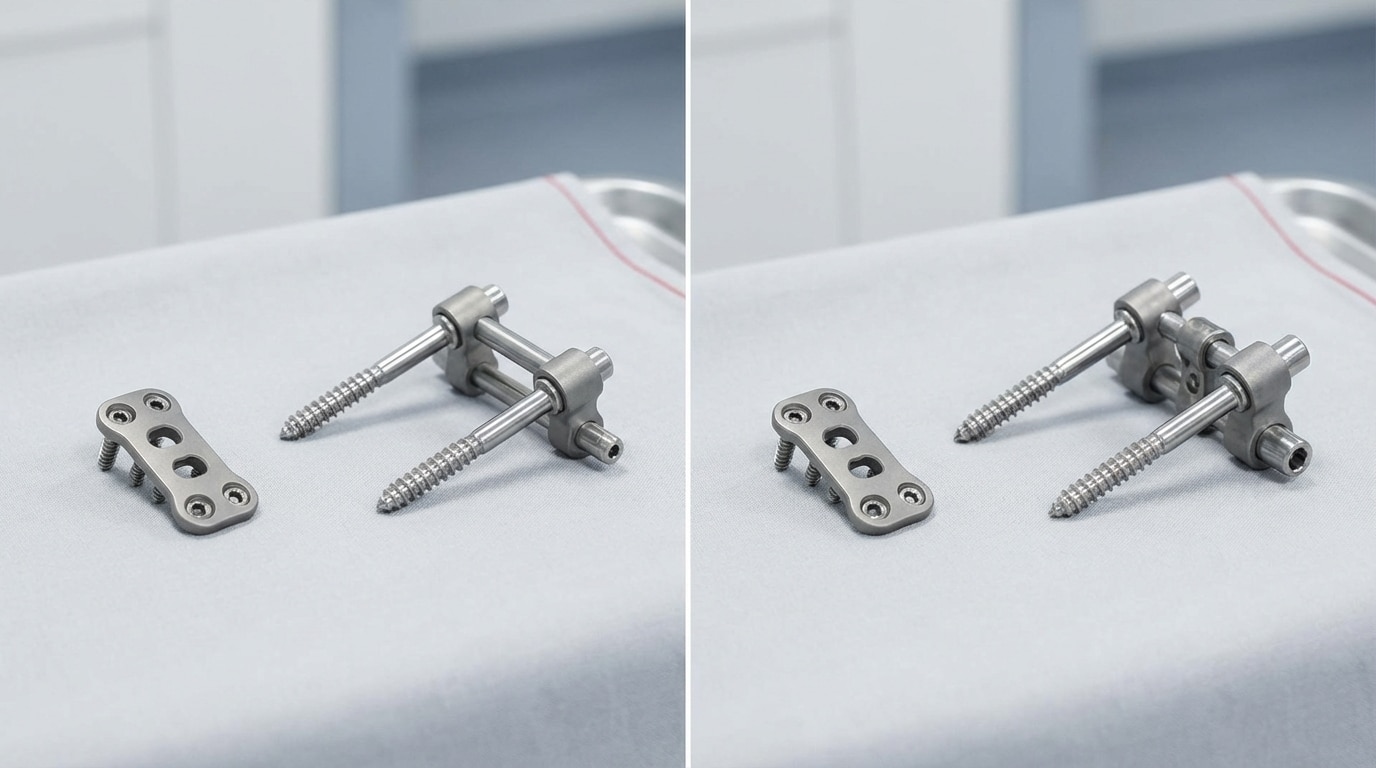
Cervical vs Lumbar Spine Implants: Key Differences
A pedicle screw is not a pedicle screw is not a pedicle screw. A 3.5mm cervical lateral mass screw and a 7.5mm lumbar pedicle screw are both threaded titanium fasteners inserted into the spine, but they solve different biomechanical problems, pass through different anatomy, and fail in different ways. The same applies to interbody cages, plates, rods, and every other device category in spine surgery. Cervical vs lumbar spine implants differ in virtually every dimension — size, geometry, fixation strategy, surgical approach, and clinical risk profile.
Understanding these differences is not academic. It is operationally critical for device representatives who cover cases in both regions, for procurement teams who stock instrumentation, and for surgical teams who need the right hardware at the right time. This guide breaks down the key differences between cervical and lumbar spine implants across every major device category — what is different, why it is different, and what it means in practice.
Anatomic Differences That Drive Implant Design
Every difference between cervical and lumbar spine implants traces back to anatomy. The cervical and lumbar spine are fundamentally different structures, and implant design follows structure.
Size
Cervical vertebrae are small. A typical C5 vertebral body measures approximately 15-17mm in anterior-posterior depth and 15-18mm in height. A typical L4 vertebral body measures 35-38mm in AP depth and 27-30mm in height. This size difference — roughly 2:1 in every dimension — cascades through every implant category. Cervical screws are 3.5-4.0mm in diameter and 12-18mm in length. Lumbar pedicle screws are 5.5-8.5mm in diameter and 35-55mm in length. Cervical interbody cages are 12-14mm wide. Lumbar interbody cages are 22-36mm wide. The instruments that deliver these implants scale accordingly.
Pedicle Anatomy
Cervical pedicles (C3-C6) are narrow (4-7mm), oriented medially, and have thin cortical walls. The vertebral artery runs immediately lateral to the cervical pedicle through the transverse foramen. A malpositioned cervical pedicle screw can injure the vertebral artery — a potentially catastrophic complication. This is why cervical pedicle screws are used selectively (primarily at C2 and C7 where pedicle anatomy is more favorable) and why lateral mass screws are the standard posterior cervical fixation method from C3 to C6.
Lumbar pedicles are large (8-18mm width depending on level and patient), sturdy, and provide a safe corridor for screw placement with a wider margin for error. The spinal canal contents at risk from a medially malpositioned lumbar screw are the cauda equina (nerve roots, not spinal cord), and the consequences of a minor breach are generally less severe than vertebral artery injury in the cervical spine.
Spinal Cord vs. Cauda Equina
The spinal cord terminates at approximately L1-L2 (the conus medullaris). Above this level, the neural structure at risk is the spinal cord itself — and spinal cord injury in the cervical region can cause quadriplegia. Below L1-L2, the canal contains the cauda equina — individual nerve roots that are more mobile, more tolerant of manipulation, and less vulnerable to permanent injury from transient compression.
This fundamental difference in neural risk drives implant design, surgical approach selection, and the margin of safety built into every cervical implant. Cervical implants and instruments are designed with tighter tolerances and less room for positional error because the consequences of error are more severe.
Lordosis and Biomechanics
The cervical spine has a lordotic curve (concave posteriorly) of approximately 20-40 degrees. The lumbar spine has a lordotic curve of approximately 40-70 degrees. Sagittal alignment requirements differ: cervical alignment is assessed by C2-C7 lordosis, C2-C7 SVA (sagittal vertical axis), and T1 slope. Lumbar alignment is assessed by lumbar lordosis, pelvic incidence-lumbar lordosis (PI-LL) mismatch, and global sagittal alignment (C7 SVA relative to the sacrum).
Interbody cages in both regions are manufactured with built-in lordotic angles to restore or maintain segmental lordosis. Cervical cages typically have 0-7 degrees of lordosis. Lumbar cages range from 0-30 degrees depending on the application, with hyperlordotic cages designed specifically for sagittal deformity correction.
Loading
The cervical spine supports the weight of the head (approximately 4.5-5.5 kg). The lumbar spine supports the weight of the entire upper body (significantly more, and amplified by lever arm effects during bending, lifting, and twisting). Lumbar implants must withstand substantially higher axial loads, higher bending moments, and higher torsional forces than cervical implants. This is reflected in the material volume, cross-sectional dimensions, and fatigue testing requirements of lumbar devices.
Posterior Fixation: Cervical vs. Lumbar
Cervical Posterior Fixation
Posterior cervical fixation uses three primary screw types, depending on the vertebral level:
- Lateral mass screws (C3-C6) — placed into the lateral mass (the bony column between the superior and inferior facets). Entry point, trajectory, and depth are critical to avoid the vertebral artery (laterally) and the nerve root (inferiorly). Multiple trajectory techniques exist (Magerl, An, Roy-Camille), each with different entry points and screw angles. Screw diameters are typically 3.5mm, lengths 12-18mm. These are short, small screws by lumbar standards.
- Cervical pedicle screws (C2, C7, and selectively C3-C6) — placed through the cervical pedicle into the vertebral body. C2 pedicle screws (also called pars screws) are the most commonly used cervical pedicle screws and provide excellent fixation strength at the C2 level. C7 has larger pedicles that safely accommodate screw placement in most patients. C3-C6 pedicle screws are placed selectively — typically with navigation guidance — when lateral mass fixation is insufficient (revision surgery, tumor, osteoporotic bone).
- C1 lateral mass screws — specialized screws placed into the lateral mass of the atlas for occipitocervical or C1-C2 fixation. The entry point and trajectory must avoid the vertebral artery in the C1 transverse foramen and the internal carotid artery anterior to the lateral mass.
Cervical rods are 3.5mm in diameter (compared to 5.5-6.0mm in the lumbar spine) and are made of titanium. The rod-screw interface uses a smaller saddle and set screw system scaled to the smaller hardware dimensions. Cervical rod systems are typically separate product lines from lumbar rod systems — they are not interchangeable.
Lumbar Posterior Fixation
Lumbar posterior fixation is pedicle-screw-based in virtually all cases. The pedicle provides a strong, reproducible fixation point that can accept large-diameter screws with high pullout strength. The large pedicle anatomy makes freehand screw placement safe and reproducible with appropriate training, though navigation and robotic guidance are increasingly used for accuracy.
Lumbar pedicle screw systems offer a wider range of screw sizes (5.5mm to 8.5mm diameter, 30mm to 60mm length) than cervical systems, reflecting the larger anatomy and the wider range of patient body habitus in the lumbar population. Multi-level lumbar constructs may use reduction screws, cross-connectors, and sacropelvic fixation (S2AI screws) — components that have no cervical equivalent because the biomechanical demands and anatomy are different.
Interbody Devices: Cervical vs. Lumbar
Cervical Interbody Cages
The standard cervical interbody procedure is ACDF — anterior cervical discectomy and fusion. The cage is placed through an anterior approach after disc removal. Cervical interbody cages are small (typically 12-14mm wide, 12-14mm deep, 5-8mm tall) and designed to fit the smaller cervical disc space.
Cervical cage materials include:
- PEEK — the most commonly used material for cervical interbody cages. Radiolucent (allows clear radiographic fusion assessment), modulus close to bone, and available in a wide range of footprints and heights.
- Structural allograft — machined cadaveric bone (cortical or corticocancellous) that serves as both the spacer and the osteoconductive scaffold. Femoral ring allograft and machined cortical allograft spacers are still widely used in ACDF.
- 3D-printed titanium — gaining adoption in cervical interbody cages, particularly zero-profile designs with integrated fixation screws.
Cervical cages are typically supplemented with an anterior cervical plate or use a zero-profile design with screws integrated directly into the cage. Standalone cervical cages without plate or integrated fixation are less common because the cervical spine’s high mobility creates higher construct demands for maintaining cage position.
Lumbar Interbody Cages
Lumbar interbody cages are larger, available in more surgical corridors (ALIF, PLIF, TLIF, LLIF), and carry more graft material. The biomechanical demands are different: lumbar cages must resist higher axial loads, provide more lordosis correction, and often need to achieve indirect decompression through disc height restoration — a goal that is less relevant in the cervical spine where direct decompression is typically performed through the same anterior approach.
Lumbar-specific cage features include:
- Expandable designs — common in lumbar but uncommon in cervical because the cervical disc space is small enough that static cages can be inserted without difficulty through the anterior cervical corridor.
- Lordotic angles up to 20-30 degrees — lumbar cages are available with aggressive lordotic angles for sagittal deformity correction. Cervical cages rarely exceed 7 degrees.
- Large footprint options — ALIF and lateral cages span the full width of the lumbar vertebral body (50-60mm). No cervical cage approaches this size.
- Supplemental posterior fixation — lumbar interbody cages are almost always combined with posterior pedicle screw fixation (with the exception of standalone ALIF cages with integrated fixation). In ACDF, the anterior plate or zero-profile cage often provides sufficient fixation without posterior instrumentation.
Plating Systems: Anterior Cervical vs. Anterior Lumbar
Anterior cervical plating is a routine component of ACDF. The plate spans the fused segment with screws into the vertebral bodies above and below. These plates are thin (1.5-2.5mm), low-profile, and designed with locking screw mechanisms that prevent screw backout. Plate lengths range from approximately 18mm (single-level) to 80mm+ (multi-level corpectomy constructs).
Anterior lumbar plating is far less common. In ALIF procedures, anterior fixation is typically provided by screws integrated into the cage itself (standalone ALIF cages) or by a separate lateral plate or dual-screw fixation system. When anterior lumbar plates are used, they are substantially larger and thicker than cervical plates to resist the higher bending and axial loads in the lumbar spine.
The key difference in plate-related complications is also regional. Anterior cervical plate prominence can cause dysphagia (difficulty swallowing) because the plate sits immediately behind the esophagus. This complication has driven the development of low-profile and zero-profile cervical devices. Anterior lumbar plates do not have this concern because the retroperitoneal approach places the hardware away from the GI tract, but vascular structures (the great vessels — aorta, vena cava, iliac vessels) are the relevant anatomic risk.
Motion Preservation: Cervical vs. Lumbar Disc Replacement
Artificial disc replacement (total disc arthroplasty) preserves motion at the treated level instead of fusing it. Both cervical and lumbar disc replacements exist, but their adoption trajectories and clinical evidence bases are very different.
Cervical Disc Replacement
Cervical TDR has strong FDA-approval data and wide adoption. Multiple devices are FDA-approved through the PMA pathway with 7-10+ year follow-up data demonstrating non-inferiority or superiority to ACDF for single-level cervical disc disease with radiculopathy. The case for cervical TDR rests on reducing adjacent segment disease (ASD) — the accelerated degeneration at levels above and below a fusion caused by altered biomechanics. Long-term data show lower rates of symptomatic ASD with cervical TDR compared to ACDF.
Current cervical TDR designs include metal-on-polyethylene (CoCr on UHMWPE), metal-on-metal (titanium or CoCr articulation), and compressible-core designs that allow both rotation and axial compression. Two-level cervical TDR is FDA-approved for some devices, and hybrid constructs (TDR at one level, ACDF at an adjacent level) are increasingly used.
Lumbar Disc Replacement
Lumbar TDR has a narrower adoption profile. FDA-approved lumbar disc replacements exist (Charite, ProDisc-L, activL), but adoption has been limited by stricter patient selection criteria (single-level disc disease without facet arthrosis, spondylolisthesis, or significant deformity), technically demanding revision surgery if the device fails, and the availability of effective lumbar fusion alternatives. Lumbar TDR is performed primarily by a subset of spine surgeons with specific training and case volume in the procedure.
The anatomic difference that matters: cervical TDR is placed through the same anterior approach used for ACDF — a familiar corridor for most spine surgeons. Lumbar TDR requires an anterior (transperitoneal or retroperitoneal) approach with vascular mobilization, which is higher-risk surgery and often requires a vascular access surgeon.
Biologic Considerations by Spinal Region
The biologic strategy for fusion differs between cervical and lumbar applications, primarily driven by two factors: the available graft volume and the safety profile of specific agents in each region.
Cervical Biologics
The cervical interbody space is small, so the volume of graft material is limited. Common cervical biologic strategies include:
- Structural allograft alone (the spacer is the graft)
- PEEK cage packed with DBM, allograft chips, or cellular allograft
- Local autograft from the uncinectomy or osteophyte removal, supplemented with DBM
BMP-2 is generally contraindicated in the cervical spine. Reports of life-threatening airway swelling from anterior cervical BMP-2 use led to an FDA safety communication and a dramatic reduction in cervical BMP use. This is one of the most important region-specific biologic distinctions. For more on biologics across all spine regions, see our spinal fusion devices guide.
Lumbar Biologics
The lumbar fusion bed accepts a larger volume of graft material, and the biologic options are broader. Local autograft from the laminectomy and facetectomy is the foundation. This is typically supplemented with DBM, cellular allograft, or in select cases BMP-2 (FDA-approved for ALIF). Posterolateral fusion beds require additional graft volume beyond the interbody space — this is where graft extenders (DBM, ceramics, cancellous allograft chips) are most commonly used.
Surgical Approaches and Instrument Differences
The surgical approach defines the instrument set, the implant options, and the risk profile. Here is a comparison of the primary approaches by region:
Cervical Approaches
- Anterior cervical (Smith-Robinson) — the workhorse approach for ACDF and corpectomy. Transverse neck incision, dissection between the carotid sheath and trachea/esophagus. Instruments include Caspar retractors, vertebral body distraction pins, fine curettes, high-speed burrs, and anterior cervical plate instrumentation. Risk structures: esophagus, recurrent laryngeal nerve, carotid artery, vertebral artery.
- Posterior cervical — midline or paramedian approach for laminectomy, lateral mass or pedicle screw fixation. Instruments include cervical screw and rod systems (3.5mm), high-speed burr for laminectomy, Kerrison rongeurs. Risk structures: vertebral artery (lateral mass and pedicle screws), spinal cord.
Lumbar Approaches
- Posterior — midline for open PLIF/TLIF, paramedian for MIS TLIF. Instruments include pedicle screw systems (5.5-6.0mm rod), interbody cage instruments, tubular retractors (MIS). Risk structures: cauda equina, nerve roots.
- Anterior (ALIF) — retroperitoneal or transperitoneal abdominal approach. Instruments include ALIF retractors, disc preparation tools, large interbody cage instruments. Risk structures: great vessels (aorta, vena cava, iliac vessels), ureter, sympathetic plexus.
- Lateral (LLIF/XLIF) — direct lateral transpsoas or anterior-to-psoas. Instruments include lateral retractors, neuromonitoring probes, lateral cage instruments. Risk structures: lumbar plexus, psoas muscle, segmental vessels.
The instrument trays for cervical and lumbar cases are completely separate. Cervical instruments are smaller, shorter-handled, and designed for the confined anterior cervical space or the narrow posterior cervical exposure. Lumbar instruments are larger, longer, and designed for deeper surgical corridors. A facility performing both cervical and lumbar spine surgery maintains separate instrument inventories for each region.
Region-Specific Complication Profiles
Understanding the complication profile differences between cervical and lumbar spine surgery informs implant selection, surgical planning, and informed consent.
Cervical-Specific Risks
- Spinal cord injury — the most feared complication. Any instrumentation error, retraction injury, or hematoma that compresses the cervical spinal cord can cause permanent quadriplegia.
- Vertebral artery injury — screw malposition or aggressive lateral decompression can injure the vertebral artery, causing stroke, hemorrhage, or death.
- Dysphagia — anterior cervical plate prominence or soft tissue swelling causing difficulty swallowing. Occurs in 30-50% of ACDF patients acutely, with 1-5% persistent at one year.
- Recurrent laryngeal nerve palsy — hoarseness from nerve injury during anterior cervical approach. More common with right-sided approaches.
- Adjacent segment disease — accelerated degeneration at levels adjacent to a cervical fusion. Drives interest in cervical disc replacement as an alternative.
Lumbar-Specific Risks
- Nerve root injury — screw malposition or cage migration can compress individual lumbar nerve roots, causing radiculopathy or motor deficit.
- Vascular injury — anterior and lateral approaches risk injury to the aorta, vena cava, or iliac vessels. Catastrophic hemorrhage is rare but is a life-threatening complication when it occurs.
- Psoas neuropraxia — lateral approaches through the psoas muscle can cause temporary lumbar plexus dysfunction (hip flexion weakness, thigh numbness). Occurs in 10-30% of lateral procedures, with most cases resolving within 6-12 weeks.
- Cage subsidence — the cage sinks into the vertebral endplate, losing height correction and foraminal decompression. More common with smaller-footprint cages on weaker central endplate bone.
- Pseudarthrosis — failure of fusion. More common in the lumbar spine (especially multi-level and posterolateral fusion) than in the cervical spine (where ACDF fusion rates exceed 95% for single-level procedures).
What Device Reps Need to Know
For device representatives who cover spine cases, the cervical-lumbar distinction is not optional knowledge — it is foundational. Here are the practical implications:
- Separate tray sets — cervical and lumbar cases require entirely different instrument trays. A rep covering a spine surgeon who performs both must manage both inventories and know both systems cold.
- Screw sizing logic is different — cervical screws are selected based on lateral mass dimensions and vertebral artery location. Lumbar screws are selected based on pedicle width and vertebral body depth. The sizing algorithms are region-specific.
- Plate application is different — anterior cervical plating is a standard part of ACDF. Anterior lumbar plating is uncommon. Knowing when and how a cervical plate is applied versus when a zero-profile device is appropriate is case-relevant knowledge.
- Biologic restrictions — BMP-2 use in the cervical spine carries specific risks and is generally avoided. A rep who supplies BMP to a lumbar case should know this restriction and understand why it applies.
- Complication awareness — understanding the region-specific complications helps the rep anticipate the surgeon’s concerns, select appropriate instrumentation, and provide meaningful case support.
For a broader look at spine instrumentation across both regions, see our spine surgery instrumentation guide and our spinal fusion devices guide.
Sourcing Cervical and Lumbar Spine Implants
A surgical facility performing spine surgery across both cervical and lumbar cases needs a supplier that stocks both product lines in depth. An incomplete cervical tray is just as case-cancelling as an incomplete lumbar tray. And because cervical and lumbar instruments are not interchangeable, inventory gaps in either system create independent operational risks.
SLR Medical Consulting supplies cervical and lumbar spine hardware, biologics, and supporting instrumentation to surgical facilities nationwide from fully stocked warehouses with zero-lead-time processing. Both systems, complete tray sets, on your schedule. Browse our spine hardware catalog or place a surgical order.
Frequently Asked Questions About Cervical vs. Lumbar Spine Implants
Why are cervical pedicle screws used less commonly than lumbar pedicle screws?
Cervical pedicles from C3 to C6 are significantly smaller than lumbar pedicles (4-7mm vs. 8-18mm in width), and the vertebral artery runs immediately lateral to the cervical pedicle through the transverse foramen. A medially malpositioned cervical pedicle screw risks spinal cord injury, and a laterally malpositioned screw risks vertebral artery injury — either of which can be catastrophic. Because of this narrow margin of safety, lateral mass screws (which avoid the pedicle and the vertebral artery corridor) are the standard fixation method from C3 to C6. Cervical pedicle screws are used primarily at C2 and C7 (where pedicle anatomy is more favorable) and selectively at other levels with navigation guidance when lateral mass fixation is insufficient.
Can the same interbody cage be used in both cervical and lumbar procedures?
No. Cervical and lumbar interbody cages are entirely different devices. Cervical cages are approximately 12-14mm wide and 5-8mm tall, sized for the cervical disc space. Lumbar cages are 22-36mm wide (or 50-60mm for ALIF and lateral cages) and 8-16mm tall. Beyond the size difference, the lordotic angles, footprint shapes, fixation mechanisms, and graft windows are all designed for the specific anatomy and biomechanics of their target region. Cervical and lumbar cages come from different product lines, different instrument trays, and are not interchangeable in any clinical scenario.
Why is BMP-2 used in lumbar fusion but avoided in cervical fusion?
BMP-2 (recombinant human bone morphogenetic protein-2, marketed as INFUSE) is FDA-approved for use in anterior lumbar interbody fusion (ALIF) with a specific cage. In the cervical spine, BMP-2 use has been associated with life-threatening soft tissue swelling that can compromise the airway — a complication that prompted an FDA safety communication. The cervical spine’s confined anterior compartment means that even modest soft tissue swelling from BMP-2’s inflammatory response can compress the trachea and esophagus. The lumbar spine’s retroperitoneal location has more soft tissue compliance and no airway at risk. For this reason, BMP-2 is generally contraindicated in the anterior cervical spine and is used in the lumbar spine under specific clinical protocols.
What are the key differences between cervical and lumbar disc replacement implants?
Cervical disc replacement (TDR) has broader FDA approval, stronger long-term data (7-10+ year follow-up from multiple IDE studies), wider clinical adoption, and more straightforward revision if needed — all performed through the familiar anterior cervical approach. Lumbar disc replacement has narrower indications (strict patient selection criteria excluding facet arthrosis, spondylolisthesis, and deformity), requires an anterior abdominal approach with vascular mobilization, has technically more demanding revision surgery, and has seen more limited adoption. The implant designs differ in size and constraint, reflecting the different biomechanical demands. Cervical TDR is a mainstream alternative to ACDF for appropriately selected patients. Lumbar TDR remains a more specialized procedure performed by a smaller subset of spine surgeons.
About SLR Medical Consulting: SLR Medical Consulting has been supplying surgical facilities nationwide for over a decade with orthopedic hardware, spine instrumentation, biologics, and sports medicine devices. Our zero-lead-time delivery model means your surgical schedule runs on your timeline, not your supply chain’s. Explore our hardware catalog or place a surgical order today.