Total Joint Replacement Implants: What Surgeons Need to Know
Total joint replacement implants are among the most successful devices in all of medicine. A well-performed total hip or total knee arthroplasty reliably eliminates pain, restores function, and returns patients to activity for 15-25 years or longer. But the clinical success of the procedure depends entirely on implant selection — bearing surface, fixation method, component geometry, and sizing all influence longevity, stability, and revision risk.
This is not a basic overview. This guide covers the decision points that matter when choosing joint replacement implants: what bearing combinations are available and which have the best survivorship data, the mechanics of cemented versus cementless fixation, how component sizing and positioning affect outcomes, and what the current evidence says about emerging technologies. It is written for orthopedic surgeons, fellows, device representatives, and procurement professionals who make or influence implant selection decisions.
Total Hip Replacement Implants
A total hip arthroplasty (THA) replaces both sides of the hip joint: the femoral head (ball) and the acetabulum (socket). The implant system has four components:
- Acetabular shell — a hemispherical metal cup (titanium or titanium alloy) press-fit or screwed into the acetabulum. The outer surface is porous-coated or 3D-printed with trabecular texture to promote bone ingrowth.
- Acetabular liner — the bearing surface that sits inside the shell. Made of polyethylene (XLPE), ceramic, or metal depending on the bearing couple selected.
- Femoral head — a sphere (28mm, 32mm, 36mm, or 40mm diameter) that articulates against the liner. Made of CoCrMo metal or ceramic (alumina or alumina-zirconia composite).
- Femoral stem — inserted into the femoral canal, providing fixation for the femoral head. Made of titanium alloy or CoCrMo, available in straight, tapered, or anatomically curved designs with various fixation philosophies.
The interaction between these four components — and the decisions the surgeon makes about each one — determines the tribological performance (wear), stability (dislocation resistance), and longevity (time to revision) of the reconstruction.
Hip Bearing Surface Options
Bearing surface selection is the most consequential implant decision in THA. The articulation between the femoral head and the acetabular liner generates wear debris over millions of gait cycles, and it is this wear debris — not the implant itself — that causes the biological response (osteolysis) leading to aseptic loosening and revision.
Metal-on-Highly-Cross-Linked Polyethylene (MoXLPE)
This is the most commonly used bearing combination worldwide and has the strongest long-term survivorship data. A CoCrMo femoral head articulates against a highly cross-linked polyethylene (XLPE) liner. Cross-linking (achieved by irradiating conventional UHMWPE with 5-10 Mrad of gamma or electron beam radiation) dramatically reduces polyethylene wear rates compared to conventional polyethylene — from approximately 0.1-0.2mm/year (conventional) to 0.01-0.05mm/year (XLPE).
Modern XLPE formulations incorporate vitamin E as an antioxidant (either blended into the polymer or diffused after irradiation) to prevent oxidative degradation without the mechanical property losses associated with post-irradiation thermal treatment (remelting or annealing). These vitamin E-stabilized XLPEs represent the current state of the art in polyethylene bearing technology.
The practical advantage of MoXLPE: it allows larger femoral head sizes (36mm and 40mm) without the wear penalty that made large heads problematic with conventional polyethylene. Larger heads increase the jump distance required for dislocation, significantly reducing dislocation rates — the most common early complication of THA.
Ceramic-on-Ceramic (CoC)
Alumina or alumina-zirconia composite (BIOLOX delta) heads articulating against ceramic liners produce the lowest volumetric wear of any bearing combination — essentially unmeasurable wear rates in laboratory testing. Ceramic bearings also eliminate the risk of metal ion release and do not produce polyethylene wear debris.
The concerns with CoC are mechanical: ceramic fracture (rare with modern delta ceramics but catastrophic when it occurs, requiring complex revision), squeaking (audible noise during hip motion, reported in 1-10% of CoC hips depending on the series), and stripe wear (accelerated wear from edge loading when component positioning is suboptimal). Ceramic liners also have less tolerance for positional error than polyethylene — a malpositioned ceramic liner cannot accommodate edge loading the way a polyethylene liner deforms to distribute load.
CoC bearings are most commonly used in younger, more active patients where the lifetime wear burden is highest and the consequences of polyethylene-induced osteolysis are most significant.
Ceramic-on-Polyethylene (CoP)
A ceramic femoral head on an XLPE liner combines the scratch resistance and wettability of the ceramic head with the forgiveness and low fracture risk of polyethylene. Some registry data suggest CoP produces slightly lower wear rates than MoXLPE, likely because the ceramic head surface is harder, smoother, and more scratch-resistant than a CoCrMo head. CoP has become an increasingly popular bearing choice, particularly with BIOLOX delta heads on vitamin E XLPE liners.
Metal-on-Metal (MoM)
Metal-on-metal bearings — once widely used in hip resurfacing and large-head THA — have largely been abandoned due to adverse local tissue reactions (ALTR) caused by cobalt and chromium ion release. Pseudotumor formation, metallosis, and soft tissue necrosis associated with MoM bearings generated significant clinical failures and product liability exposure. The remaining clinical role for MoM is limited to select hip resurfacing cases in young male patients with specific anatomic criteria, performed by high-volume resurfacing surgeons.
Hip Fixation: Cemented vs. Cementless
Cementless fixation is the dominant fixation method for THA in North America and most of Europe. Both the acetabular shell and femoral stem achieve initial stability through press-fit (mechanical interlock with the prepared bone) and long-term fixation through bone ingrowth into the porous or textured surface coating.
Acetabular shells are press-fit with 1-2mm of interference (the shell is slightly larger than the reamed acetabulum) and may be supplemented with screws through the shell into the pelvis. Modern porous coatings — titanium plasma spray, sintered beads, fiber mesh, and 3D-printed trabecular titanium — all achieve reliable bone ingrowth when initial stability is achieved and micromotion at the bone-implant interface is less than 50-150 microns.
Cementless femoral stems achieve initial rotational and axial stability through the fit of the stem geometry within the prepared femoral canal. Tapered-wedge designs (flat, trapezoidal cross-section) achieve stability through metaphyseal wedging. Fit-and-fill designs achieve stability through circumferential cortical contact along the length of the stem. Both philosophies work — the choice depends on canal morphology and surgeon training.
Cemented fixation uses polymethylmethacrylate (PMMA) bone cement to fill the gap between the implant and the prepared bone surface. Cemented fixation provides immediate, full weight-bearing stability and does not depend on bone quality for fixation. In patients with osteoporotic bone, wide femoral canals (Dorr C morphology), or fracture patterns that compromise metaphyseal bone stock, cemented femoral fixation may be the safer choice.
The cemented all-polyethylene acetabular component has excellent long-term survivorship data in lower-demand patients (over 70, less active) and is significantly less expensive than a cementless titanium shell with a modular liner. Scandinavian registry data consistently demonstrate outstanding survivorship for cemented THA constructs when modern cementing technique is used.
Hip Component Sizing and Positioning
Implant selection does not end with bearing surface and fixation method. Component sizing and positioning directly affect stability, leg length, offset, impingement-free range of motion, and wear performance.
- Femoral head size — larger heads (36mm, 40mm) increase stability by increasing the head-to-neck ratio and jump distance. The trade-off is increased volumetric wear (more bearing surface area in motion) — but with modern XLPE, this wear increase is clinically acceptable. 36mm is the most common head size in current practice.
- Acetabular component position — the “safe zone” for cup positioning (Lewinnek zone: 40 +/- 10 degrees of inclination, 15 +/- 10 degrees of anteversion) defines the range where dislocation risk is minimized. Component positioning outside this range — particularly excessive inclination — increases edge loading on the bearing surface and dislocation risk. Navigation, robotics, and intraoperative fluoroscopy are all tools to improve cup positioning accuracy.
- Femoral offset and leg length — restoring the patient’s native offset (the perpendicular distance from the center of the femoral head to the femoral shaft axis) is essential for gluteal muscle tension and gait mechanics. Leg length discrepancy is the most common patient complaint and litigation driver after THA. Templating, intraoperative measurement, and navigation all aim to restore equal leg lengths.
- Stem sizing — undersizing risks micromotion and failure of ingrowth. Oversizing risks intraoperative fracture (particularly with cementless tapered-wedge designs) and thigh pain from distal stem engagement. Preoperative templating on calibrated radiographs or CT-based planning guides stem size selection.
Total Knee Replacement Implants
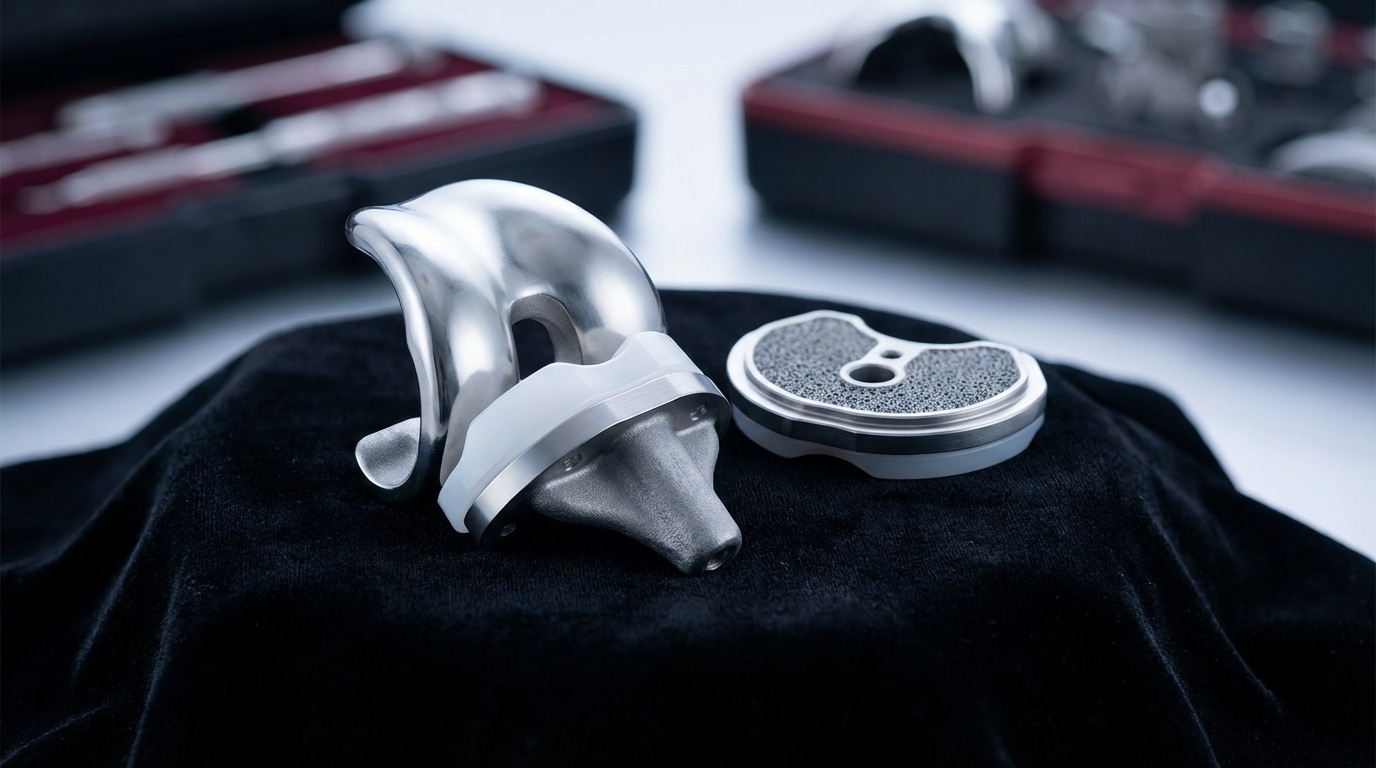
A total knee arthroplasty (TKA) resurfaces three compartments of the knee joint: the medial tibiofemoral, lateral tibiofemoral, and patellofemoral compartments. The implant system has three or four components:
- Femoral component — a CoCrMo or oxidized zirconium (Oxinium) cap that resurfaces the distal femoral condyles. Shaped to replicate the sagittal curvature of the femoral condyles and maintain normal knee kinematics through the arc of flexion.
- Tibial baseplate — a titanium or CoCrMo tray that sits on the resected proximal tibia, with a keel or pegs for fixation.
- Tibial insert (polyethylene) — a XLPE or conventional UHMWPE bearing surface that snaps into or locks onto the tibial baseplate. The articular surface geometry (flat, dished, or highly conforming) is determined by the level of constraint selected.
- Patellar component (optional) — a polyethylene button cemented to the resected patella. Whether to resurface the patella is a clinical decision that varies by surgeon preference and implant design.
Knee Implant Design Variables
Cruciate-Retaining (CR) vs. Posterior-Stabilized (PS)
This is the fundamental design choice in TKA. A CR design preserves the posterior cruciate ligament (PCL) and relies on it for femoral rollback during flexion. The tibial insert is relatively flat or minimally dished. A PS design sacrifices the PCL and substitutes its function with a cam-and-post mechanism — a spine on the tibial insert engages a cam on the femoral component during flexion, mechanically driving femoral rollback.
The debate between CR and PS has persisted for decades without clear resolution in the literature. CR designs preserve native structures and avoid the failure mode of post wear or fracture. PS designs provide more predictable kinematics (not dependent on PCL function) and may achieve higher flexion in some patients. Registry data show comparable survivorship for both designs.
Medial-Pivot and Bi-Cruciate Designs
Medial-pivot TKA designs replicate the native knee’s medial ball-and-socket articulation with lateral femoral rollback. The medial compartment has a highly conforming, congruent articulation while the lateral compartment allows translation and rotation. Proponents argue this produces more natural-feeling knee kinematics. Bi-cruciate-retaining (BCR) designs preserve both the ACL and PCL, attempting to maintain near-normal knee kinematics. BCR designs are technically demanding and represent a small but growing segment of the market.
Fixed-Bearing vs. Mobile-Bearing
In fixed-bearing designs, the polyethylene insert is locked to the tibial baseplate. In mobile-bearing (rotating platform) designs, the insert rotates on the tibial baseplate, theoretically reducing contact stress on the polyethylene and accommodating rotational mismatch. Despite theoretical advantages, multiple randomized trials and registry analyses have failed to demonstrate a clinical difference in survivorship, function, or patient satisfaction between fixed and mobile bearings. Fixed-bearing designs dominate current practice.
Constraint Levels
TKA implants are available in increasing levels of constraint:
- CR / PS — standard primary TKA constraint levels
- Varus-valgus constrained (VVC) — a larger post-and-cam mechanism that resists varus/valgus stress. Used when collateral ligament insufficiency is present (complex primary or revision cases)
- Rotating hinge — a linked articulation that provides constraint in all planes. Reserved for severe bone loss, ligament deficiency, or complex revision situations
Higher constraint transfers more stress to the implant-bone interface, increasing the risk of aseptic loosening. The principle is to use the minimum constraint necessary to achieve a stable knee.
Knee Fixation Methods
Unlike THA, where cementless fixation dominates, cemented fixation remains the standard for TKA in most practice settings. The femoral component, tibial baseplate, and patellar component are all typically fixed with PMMA bone cement. The evidence supporting cemented TKA is among the strongest in orthopedics — national registry data from Australia, Sweden, and the UK consistently show cemented TKA has superior survivorship compared to cementless or hybrid fixation, particularly at longer follow-up intervals.
Cementless TKA has gained interest in younger patients where future revision is anticipated and preserving bone stock (avoiding the cement mantle) may facilitate easier revision. Modern cementless tibial baseplates and femoral components use porous titanium or trabecular metal surfaces for bone ingrowth. Early and mid-term results are encouraging, but long-term registry data are still maturing.
Hybrid fixation — cemented tibial component with a cementless femoral component — is practiced by some surgeons based on the observation that tibial loosening is the more common mode of fixation failure, so the tibial component benefits most from the reliable fixation of cement.
Knee Sizing, Alignment, and Balancing
The technical challenge in TKA is not the implant itself — it is the surgical execution. Component sizing, alignment, and soft tissue balancing determine whether the knee feels normal to the patient or produces stiffness, instability, or anterior knee pain.
- Alignment philosophy — mechanical alignment (restoring a neutral mechanical axis from hip center to ankle center) has been the standard for decades. Kinematic alignment (restoring the patient’s native joint line and constitutional alignment) has emerged as an alternative, with proponents arguing it produces more natural-feeling knees. The debate is active and unresolved in the literature.
- Component sizing — the femoral component must match the anteroposterior (AP) and mediolateral (ML) dimensions of the distal femur. An oversized femoral component overstuffs the patellofemoral joint and limits flexion. An undersized component under-covers the cut bone surface and creates a mechanical mismatch. Most implant systems offer standard and narrow (or gender-specific) femoral component options.
- Gap balancing — the flexion and extension gaps (the space between the resected femoral and tibial surfaces) must be equal and rectangular. Unbalanced gaps produce mid-flexion instability, flexion contracture, or asymmetric laxity. Measured resection (anatomic bone cuts) and gap balancing (adjusting bone cuts to equalize gaps) are the two primary techniques.
- Robotic assistance — platforms like the Stryker Mako, Smith+Nephew CORI, and Zimmer Biomet ROSA provide real-time feedback on bone resection accuracy, gap measurements, and soft tissue tension. These systems are tools for surgical precision — they do not replace surgical judgment.
For a detailed look at the screws, plates, and fixation hardware that complement arthroplasty, see our guide to orthopedic screws and plates.
Shoulder Replacement: Anatomic and Reverse
Shoulder arthroplasty has undergone a dramatic shift over the past decade. Reverse total shoulder arthroplasty (RTSA) — originally designed for rotator cuff arthropathy — now accounts for more than half of all shoulder replacements performed in the United States. In the reverse design, the ball (glenosphere) is placed on the glenoid side and the socket (humeral cup) on the humeral side, reversing the native anatomy. This configuration medializes and distalizes the center of rotation, which recruits the deltoid as the primary elevator of the arm, bypassing the deficient rotator cuff.
Anatomic total shoulder arthroplasty (aTSA) preserves the native configuration — humeral head on a stemmed component, glenoid resurfaced with a polyethylene component. aTSA requires a functional rotator cuff and intact glenoid bone stock. In younger patients with concentric glenohumeral arthritis and a healthy rotator cuff, aTSA produces the most natural shoulder kinematics and best rotational strength.
The trend toward RTSA in expanding indications (proximal humerus fractures, failed aTSA, massive cuff tears without arthritis) has driven implant design evolution: lateralized glenosphere designs reduce scapular notching, 135-degree neck-shaft angle humeral components improve rotational motion, and augmented baseplates address glenoid bone deficiency without bone grafting.
Emerging Technologies in Joint Replacement
- Patient-specific instrumentation (PSI) — 3D-printed cutting guides manufactured from preoperative CT or MRI data, customized to the individual patient’s anatomy. PSI can reduce surgical time and improve resection accuracy, though the evidence on clinical outcome improvement is mixed.
- Custom implants — 3D-printed implants designed to match the individual patient’s anatomy, particularly for complex revision cases with significant bone loss. These require preoperative CT-based planning and manufacturing lead time but can provide solutions where off-the-shelf implants do not fit.
- Smart implants — sensor-equipped tibial components (e.g., Zimmer Biomet’s Persona IQ) that transmit data on knee kinematics and activity levels postoperatively. These devices are in early clinical use and may inform rehabilitation protocols, detect early implant problems, and contribute to outcomes research.
- Robotic-assisted surgery — adoption continues to grow, with systems from Stryker, Smith+Nephew, Zimmer Biomet, DePuy Synthes, and others competing for market share. The systems are converging on a common model: CT-based preoperative planning, intraoperative registration, real-time haptic or visual feedback during bone preparation, and gap/alignment verification before implant placement.
Sourcing Joint Replacement Implants
Joint replacement implant procurement is high-stakes. A single total knee case uses $3,000-$8,000 in implants (depending on the system, facility type, and contract). A total hip case uses $3,500-$10,000. At scale, implant selection is a major line item — and a major margin driver or eroder depending on reimbursement structure.
For ASCs performing joint replacement under bundled payment models, implant cost as a percentage of the facility fee is the critical economic variable. A $2,000 difference in implant cost per case across 200 cases per year is $400,000 in margin impact. This is why implant pricing, inventory availability, and supplier reliability are not procurement details — they are strategic decisions.
SLR Medical Consulting supplies joint replacement implants, orthopedic hardware, and biologics to surgical facilities nationwide with zero-lead-time delivery from fully stocked warehouses. Browse our implant catalog or place a surgical order to get your facility’s joint program running without supply chain friction. For guidance on evaluating suppliers, see our orthopedic surgical implants guide.
Frequently Asked Questions About Total Joint Replacement Implants
What bearing surface has the best long-term survivorship data for total hip replacement?
Metal-on-highly-cross-linked polyethylene (MoXLPE) has the strongest long-term survivorship data across national joint registries. Modern XLPE formulations (particularly vitamin E-stabilized cross-linked polyethylene) produce wear rates of 0.01-0.05mm/year — a 75-90% reduction compared to conventional polyethylene. Ceramic-on-polyethylene (CoP) shows comparably excellent results and may produce marginally lower wear due to the superior surface properties of the ceramic head. Ceramic-on-ceramic produces the lowest measurable wear but carries a small risk of ceramic fracture and squeaking. Metal-on-metal is no longer recommended for standard THA due to adverse tissue reactions.
Is cemented or cementless fixation better for total knee replacement?
Cemented fixation remains the gold standard for TKA based on national registry data. The Australian, Swedish, and UK national joint registries consistently show lower revision rates for all-cemented TKA compared to cementless or hybrid constructs, particularly at 10+ years of follow-up. Cementless TKA is an option in younger patients where bone stock preservation may facilitate future revision, and early results with modern porous-coated designs are encouraging. However, the long-term evidence base still favors cemented fixation for most patient populations.
What is the difference between anatomic and reverse total shoulder replacement?
Anatomic total shoulder arthroplasty (aTSA) preserves the native shoulder configuration — ball on the humeral side, socket on the glenoid side. It requires a functional rotator cuff and produces the most natural shoulder kinematics. Reverse total shoulder arthroplasty (RTSA) flips this configuration — the ball (glenosphere) is on the glenoid and the socket on the humeral side. This shifts the center of rotation, allowing the deltoid muscle to power overhead elevation even when the rotator cuff is torn or absent. RTSA is indicated for cuff tear arthropathy, irreparable rotator cuff tears, complex proximal humerus fractures, and failed anatomic arthroplasty.
How does implant cost affect surgical facility margins in joint replacement?
In hospital outpatient and ASC settings operating under bundled payment models, implant cost is the single largest variable cost per case — typically 40-60% of the total direct cost. A facility performing 200 joint replacements per year at $2,000 more per implant than necessary is losing $400,000 in annual margin. This makes implant cost negotiation, supplier selection, and volume consolidation direct margin levers. Facilities should evaluate implant cost as a percentage of reimbursement per case, negotiate cap pricing or per-case maximums, and consolidate volume with fewer suppliers to maximize purchasing power.
About SLR Medical Consulting: SLR Medical Consulting has been supplying surgical facilities nationwide for over a decade with orthopedic hardware, spine instrumentation, biologics, and sports medicine devices. Our zero-lead-time delivery model means your surgical schedule runs on your timeline, not your supply chain’s. Explore our hardware catalog or place a surgical order today.