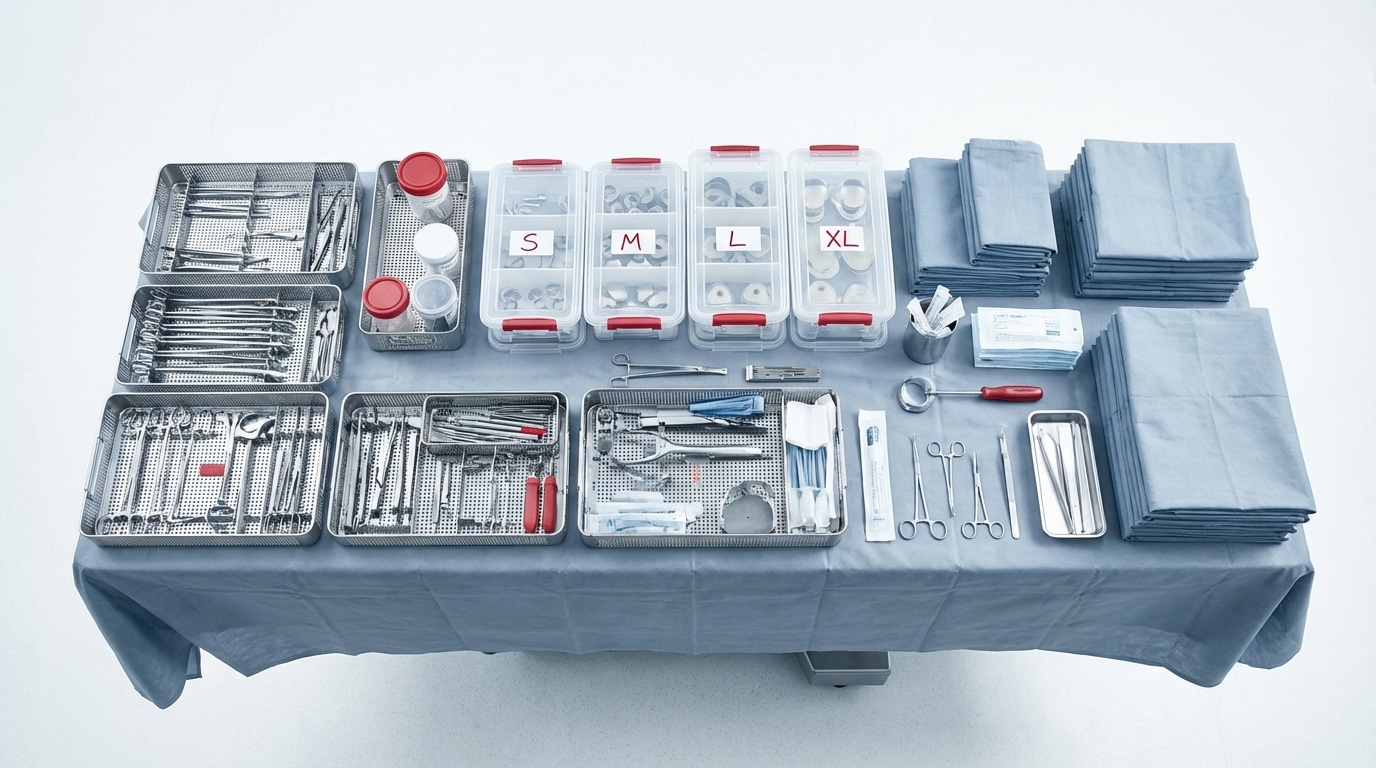
How to Cover a Surgical Case: The Complete Field Guide for Device Reps
Covering a surgical case is the core deliverable of a medical device sales rep. Everything else you do — the territory development, the surgeon meetings, the product evaluations, the pricing negotiations — exists to put you in an operating room, supporting a surgeon, ensuring the right implants and instruments are on the back table, and adding clinical value to a procedure that directly affects a patient’s life.
New reps often underestimate how much goes into covering a single case. It is not showing up, standing in the corner, and handing the surgeon a brochure afterward. Case coverage is a multi-phase operation that starts days before the surgery and does not end until the paperwork is done, the trays are returned, the billing information is submitted, and the post-op follow-up is handled. Doing it well, consistently, is what separates reps who build lasting surgeon relationships from reps who get replaced.
This guide walks through the complete process of covering a surgical case — from the moment you learn the case is on the schedule to the last piece of post-case documentation. It is written for reps who are new to case coverage or who want to tighten an existing workflow. The principles apply across orthopedics, spine, sports medicine, and trauma, though specific details will vary by specialty and product line.
Phase 1: Pre-Case Planning
Case coverage starts the moment you know the surgery is scheduled. For elective procedures, this is typically 1-4 weeks before the case date. For trauma and urgent add-ons, it might be hours. Either way, the preparation checklist is the same — you just compress the timeline.
Get the Case Details
You need the following information before you can prepare:
- Procedure. Exactly what is being done. “Total knee” is not enough. Is it a primary or revision? Which approach? Is the surgeon using a robotic platform? Is it a complex case with bone loss or deformity? The specifics determine what you bring.
- Patient demographics. Age, sex, body habitus, relevant comorbidities — not for your medical records, but because they affect implant selection. A 55-year-old active male getting a total hip will likely need different sizing and component options than an 80-year-old female with osteoporosis.
- Imaging. Preoperative X-rays, CT scans, or MRI that allow you to template the case. If the surgeon uses AI-powered preoperative planning software, you may need to ensure the imaging has been uploaded and the plan has been generated before the case day.
- Surgeon’s implant preferences. Which implant system? Which specific components within that system? Does the surgeon have standing preferences (they always use a cemented tibial component, they prefer a specific stem design in hips, they default to a particular screw diameter in spine), or do they decide case by case?
- Facility and OR logistics. Which facility? Which OR room? What time? First case or later in the day? Does the facility require trays to arrive the day before for sterile processing, or can you deliver morning-of?
This information typically comes from the surgeon’s office (the surgical scheduler or PA), from the facility’s OR schedule, or directly from the surgeon. Build a reliable channel for getting case details early. If you are chasing down case information the day before surgery, you are already behind.
Template the Case
Templating means using preoperative imaging to estimate the implant sizes the surgeon will need. For joint replacement, this involves overlaying implant templates on X-rays or using digital planning software to determine the most likely femoral, tibial, and acetabular component sizes. For spine, it means estimating screw diameters, lengths, rod diameters, and interbody cage sizes based on the anatomy.
Templating serves two purposes: it ensures you bring the right sizes (including one size above and below the estimated size), and it gives you a starting point for intraoperative discussion with the surgeon. Walking into the OR with a templated plan signals preparation. Walking in blind signals the opposite.
Assemble the Inventory
Based on the case details and your templating, pull the required implants and instrumentation:
- Primary implants. The sizes the surgeon is most likely to use based on the preoperative plan.
- Backup sizes. One size above and below in every dimension. For joint replacement, this includes femoral, tibial, and bearing/poly options. For spine, this includes screw diameters, lengths, and rod sizes. Not having a backup size when the surgeon needs to change the plan intraoperatively is one of the most common and most damaging rep failures.
- Instrumentation trays. The complete instrument set required for the procedure. Verify every tray is complete before it leaves your control. Open each tray, check the instrument list, confirm nothing is missing or damaged. A missing rongeur or a broken drill bit discovered during the case is your problem, not the facility’s.
- Specialty items. Augments, wedges, constrained liners, offset stems, revision components — anything that might be needed if the case becomes more complex than expected. Discuss with the surgeon what backup options they want available.
- Biologics. If the case involves bone graft, demineralized bone matrix, or other biologics, confirm availability, lot numbers, and expiration dates.
- Disposables and consumables. Per-case disposable items required by the robotic platform or instrumentation system. Pulse lavage tips, drill bits, saw blades — items that cannot be reused.
Your hardware inventory needs to be organized, tracked, and accurate. An inventory management system — whether it is a dedicated software platform or a meticulously maintained spreadsheet — is not optional for reps covering multiple cases per week.
Phase 2: Day-Before Preparation
The day before the case is your final preparation window. Everything should be confirmed, packed, and ready to deliver.
Confirm the Case
Cases get canceled, rescheduled, and changed. Call the surgeon’s office or check the facility’s OR schedule to confirm:
- The case is still on the schedule
- The procedure has not changed
- The start time is unchanged
- No new information has come in (updated imaging, change in surgical plan, patient health change)
Discovering a case was canceled after you have already driven an hour to deliver trays is a waste of time and money. Discovering the case changed from a primary to a revision after you have packed only primary components is worse.
Deliver Trays and Implants
Most facilities require loaner trays and implants to arrive the day before surgery so their sterile processing department has time to decontaminate, inspect, and sterilize reusable instrumentation. Know the facility’s delivery cutoff time and meet it. Typical requirements:
- Deliver to the facility’s receiving dock or materials management department
- Include a detailed packing list with every tray and implant container listed
- Ensure all trays have been inspected and are complete before delivery
- Provide tray configuration guides or quick-reference cards for the sterile processing team if the instrument sets are new to the facility
- Confirm receipt with the receiving department and get a signature or confirmation number
For facilities where you deliver morning-of (common in ASCs with limited sterile processing capacity and pre-sterilized instrument systems), your delivery timing is even more critical. Late delivery means a delayed case.
Final Review
Before you leave for the night, review the case one more time:
- Do you have everything the surgeon needs?
- Do you have backup sizes for every implant?
- Are the trays complete and accounted for?
- Do you know the start time and arrival time?
- Is your credential current at the facility?
- Do you have your lead apron, badge, and any personal items you need?
Build a pre-case checklist and use it every time. The checklist catches the detail you would have forgotten at 5:30 AM when you are loading your car in the dark.
Phase 3: Day-of Arrival and Setup
Surgery days start early. A first case at 7:30 AM means you should be at the facility by 6:00-6:15 AM at the latest. Here is the arrival sequence.
Check In
- Sign the vendor log at the front desk or security station
- Display your badge and credential verification
- Change into facility-provided scrubs
- Store personal belongings in the vendor locker or designated area
Verify Your Trays
Go to the OR or the sterile processing department and confirm:
- Your trays were received and processed
- All trays are accounted for and have been sterilized (check the sterilization indicator)
- Implants that arrived in sealed sterile packaging are staged and ready
- Nothing was held up in processing
If there is a problem — a tray was not processed, an instrument set is missing, sterile processing flagged an issue with a container — you need to know now, while there is still time to fix it before the surgeon arrives.
Set Up the Room
Work with the scrub tech to set up the back table and instrument trays. This is where your product knowledge matters. The scrub tech may be experienced with your system or may be seeing it for the first time. Either way:
- Walk them through the instrument layout and the sequence they will use during the case
- Point out any instruments that look similar but serve different functions
- Identify the critical instruments and implant trials the surgeon uses most frequently
- Confirm the implant options are organized and accessible
- Set up any technology — navigation systems, robotic platforms, imaging equipment — that you are responsible for
A thorough setup briefing with the scrub tech prevents confusion during the case. It takes five minutes and saves twenty. Good OR etiquette starts with how you prepare the room before the patient arrives.
Pre-Case Huddle
Many facilities conduct a pre-operative briefing or “time-out” before the procedure. This typically includes the surgeon, anesthesiologist, circulating nurse, and scrub tech. As the device rep, you may be asked to confirm that the correct implants and instrumentation are available for the planned procedure. Be prepared to do so concisely and accurately. “We have a full primary knee set with sizes 2 through 7 femoral, a through f tibial, cemented and cementless options, and poly thicknesses from 9 to 15 millimeters” is the format. Short, specific, complete.
Phase 4: Intraoperative Support
This is where you earn your keep. The case is live. The patient is on the table. Your job is to support the surgeon and the scrub tech through every phase of the procedure.
Positioning and Readiness
Position yourself where you can see the surgical field (or the monitor for arthroscopic cases), communicate with the scrub tech, and be accessible to the surgeon without obstructing anyone’s workflow. You should have a clear view of the instrumentation sequence and be ready to open implants, provide sizing information, and answer technical questions at any moment.
Following the Surgical Sequence
Know the surgical technique for your product system step by step. You should be able to anticipate what the surgeon needs before they ask for it. In a total knee replacement, for example:
- Approach and exposure — know which retractors and cutting guides are used
- Bone cuts — know the sequence (typically distal femur, proximal tibia, then femoral sizing and rotation), the instruments for each cut, and how the surgeon verifies alignment
- Trial reduction — know which trial components the surgeon will use, how gap balancing is assessed, and what adjustments are available
- Final implant selection — based on trial results, the surgeon commits to specific implant sizes. You need to have them ready to open immediately
- Implantation — know the cementing technique, the insertion sequence, and any specific steps required by the implant design
- Final assessment — range of motion, stability testing, imaging if needed
- Closure — your direct involvement typically decreases during closure, but stay attentive
Opening Implants
When the surgeon calls for a specific implant, you open it using sterile technique:
- Verify the implant matches what the surgeon requested — correct side (left/right), correct size, correct type
- Check the lot number and expiration date before opening
- Peel the outer packaging and present the sterile inner package to the scrub tech
- Do not touch the sterile inner package or the implant itself
- Record the lot number, catalog number, and description for post-case documentation
Opening the wrong implant is a costly and embarrassing mistake. Double-check before you peel. If the packaging is damaged or the sterile indicator shows a breach, do not open it — pull an alternative.
Providing Technical Support
During the case, the surgeon may ask for technical input: sizing recommendations, instrumentation adjustments, product-specific technique tips. Provide clear, direct answers based on your product knowledge and the clinical data. If you are unsure about something, say so and offer to check. A confident wrong answer is more dangerous than an honest “let me verify that.”
If you see a potential issue — the surgeon is about to use an instrument incorrectly, a sizing mismatch between the trial and the final implant, an instrumentation step that was skipped — speak up promptly and respectfully. “Dr. Johnson, that trial is a size 4 but the final component you selected is a size 5 — did you want to re-trial with the 5 before we commit?” This kind of catch is exactly why surgeons want knowledgeable reps in the room.
Handling Plan Changes
Surgical plans change intraoperatively. The bone quality is worse than expected. The anatomy does not match the imaging. The primary implant does not fit. The surgeon decides to add a procedure. Your job is to adapt immediately:
- If the surgeon needs a different size, have it available or tell them immediately if you do not
- If the case converts from a primary to a revision approach, assess what additional implants and instruments you have and what you need to source
- If the surgical plan changes significantly, confirm the revised plan with the surgeon so you are tracking the new sequence
The ability to adapt calmly and competently when a case goes off-plan is what separates an experienced rep from a new one. This is where preparation pays off — the backup sizes, the extra trays, the “just in case” inventory. All of it exists for the moment when the plan changes and the surgeon needs options.
Phase 5: Post-Case in the OR
The case is done. The surgeon closes. The patient goes to recovery. Your work is not finished.
Implant Reconciliation
This is the most critical post-case task. You must account for every implant:
- Implanted. Record every component that was implanted in the patient. Catalog number, lot number, size, side, and description. This information goes on the implant record and is required for billing, warranty tracking, and patient records.
- Opened but not implanted. If trial implants or alternate sizes were opened but not used, they must be identified and handled according to the facility’s policy. Some can be resterilized and returned to inventory. Some are considered compromised and must be discarded or returned to the manufacturer.
- Not opened. Confirm that all unopened implants are accounted for and returned to your inventory. A missing implant that is not accounted for is a billing liability and an inventory management failure.
Instrument Count
Work with the scrub tech and circulating nurse to verify the instrument count. Every instrument that went onto the sterile field must be accounted for before the patient leaves the room. This is a patient safety protocol — a retained surgical instrument is a serious surgical complication. If an instrument is missing from the count, the case does not end until it is found.
Tray Management
After the count, your instrument trays need to be handled:
- Used trays go to sterile processing for decontamination before you can take them back
- Unused trays that remained sealed can typically be retrieved without reprocessing
- Know the facility’s policy on tray retrieval timing — some allow same-day pickup, others require next-day
- When you receive trays back, inspect them for completeness and damage before you leave the facility
Surgeon Debrief
If the surgeon is available and willing, a brief post-case conversation is valuable:
- How did the procedure go from their perspective?
- Any concerns about the implants or instrumentation?
- Any changes they want for the next case?
- Any follow-up information they need from you?
This does not need to be a formal meeting. A two-minute conversation while the surgeon writes their operative note is enough. The point is to close the loop on this case and set up the next one. Building lasting surgeon relationships happens one post-case debrief at a time.
Phase 6: Post-Case Administration
The administrative work after a case is not glamorous, but it is essential. Miss it, and you create billing problems, inventory discrepancies, and compliance exposure.
Documentation
- Implant usage report. Submit a detailed record of every implant used to your distributor or manufacturer. This drives billing, commission calculation, and inventory replenishment. Submit it the same day as the case if possible.
- Facility paperwork. Complete any facility-required vendor documentation — implant sticker sheets for the patient chart, usage forms for materials management, billing verification for the business office.
- Your own records. Log the case in your personal tracking system: date, facility, surgeon, procedure, products used, any notes about the case for future reference.
Billing Coordination
In many distributor models, the rep is responsible for ensuring accurate billing information reaches the right parties. This includes:
- Verifying that the implants billed match the implants used (overbilling is a compliance violation; underbilling is leaving money on the table)
- Confirming pricing against the facility’s contract or purchase order
- Resolving discrepancies quickly — a billing dispute that lingers damages your relationship with the facility’s business office
Inventory Replenishment
Replace what you used. If you implanted a size 5 femoral component and a size C tibial tray, those sizes need to be replenished in your inventory immediately so they are available for the next case. If you used disposable items, reorder them. If an instrument was damaged during the case, arrange for replacement. Your inventory should be back to full readiness before your next case, not the morning of.
Follow-Up
Depending on the surgeon and the case, post-operative follow-up may include:
- Checking with the surgeon’s office on the patient’s post-op status (appropriate for complex cases or cases where there were intraoperative concerns)
- Providing the surgeon with any technical information they requested during the case
- Sending the surgeon any relevant clinical data, surgical technique updates, or product information they expressed interest in
- Following up on any product issues identified during the case
Handling Special Situations
Trauma and Emergency Add-Ons
Trauma does not wait for your schedule. When a surgeon calls with an emergency case, your response time and ability to deliver the right products on short notice are the ultimate test of your logistics capability. Have an emergency protocol:
- Keep a trauma-ready inventory of common implants and instruments accessible at all times
- Know which facilities you can reach within 30, 60, and 90 minutes
- Have a backup plan for cases you physically cannot cover — a colleague, a sub-rep, or an emergency delivery arrangement with your distributor
Multiple Cases in One Day
Busy reps cover 2-4 cases per day, sometimes at different facilities. The logistics get complex fast:
- Tray management becomes critical — you may need the same instrument set at two facilities on the same day, which requires duplicate trays or precise timing
- Travel between facilities adds time pressure
- Post-case documentation from the morning cases needs to happen before the afternoon cases push it out of your memory
The complete guide to medical device sales covers the business side of managing high case volume. The operational side comes down to systems: checklists, inventory management, route planning, and disciplined post-case workflows.
New Product Introductions
Covering the first few cases with a new product system requires extra preparation. You are learning the instrumentation in a live setting, the scrub tech is seeing the trays for the first time, and the surgeon may be on their learning curve with the product. Plan for longer setup times, more intraoperative questions, and more post-case discussion. Bring the product’s surgical technique guide and have it accessible during the case. Over-communicate with the scrub tech on instrument sequencing.
Cases That Go Wrong
Complications happen. Implants fracture. Bone cracks. Instruments break. Bleeding occurs. When a case goes wrong, your job is to stay calm, provide whatever technical support the surgeon needs, and ensure that additional implants or instruments are available if the surgeon needs to change their approach. Do not panic. Do not disappear. Do not offer medical opinions. Be a steady, competent technical resource and let the surgeon manage the clinical situation.
After a case with a significant complication, document everything thoroughly. If the complication involved your product (an implant failure, an instrument malfunction), report it to your distributor and manufacturer immediately. Certain device-related adverse events must be reported to the FDA under the Medical Device Reporting (MDR) regulations. Know your obligations and follow them.
Common Mistakes in Case Coverage
These are the errors that new reps make most frequently and that experienced reps still make when they get complacent.
- Arriving late. There is no acceptable excuse for being late to a surgical case. Traffic, alarm failures, personal issues — none of it matters to the surgeon and patient who are waiting. Leave earlier than you think you need to. Build buffer time into every case day.
- Incomplete trays. A missing instrument discovered during the case means someone counted wrong, packed wrong, or did not check. Inspect your trays before every delivery. Every time.
- Missing backup sizes. The surgeon needed a size 6 and you only brought 4 through 5. The case is now delayed while you figure out a solution. Bring the range. Every time.
- Not knowing the surgical plan. Walking into the OR without reviewing the imaging, the templating, and the surgeon’s planned approach. You should never be surprised by what is happening during a case you prepared for.
- Poor communication with the scrub tech. Failing to brief the tech on the tray layout and instrument sequence. Assuming they know your system. Not confirming that instruments are assembled correctly before the case starts.
- Sloppy documentation. Wrong lot numbers, missing implant records, delayed billing submissions. Administrative errors create downstream problems that affect your reputation with the facility and your income.
- Not debriefing with the surgeon. Leaving after the case without checking in. Missing the opportunity to address concerns, gather feedback, and strengthen the relationship.
Building Your Case Coverage System
Covering cases well is not about being naturally organized. It is about building a system that prevents errors and runs consistently regardless of how many cases you have, how early you wake up, or how complex the schedule gets.
The Pre-Case Checklist
Create a standardized checklist for every case. Print it, laminate it, tape it to the inside of your tray case. Use it every time. It should cover:
- Case confirmation (date, time, facility, surgeon, procedure)
- Patient-specific details (imaging reviewed, templating complete, sizes estimated)
- Inventory confirmation (primary implants, backup sizes, instrumentation, disposables, biologics)
- Tray inspection (complete, functional, clean)
- Logistics confirmation (delivery time, credential status, PPE ready)
The Post-Case Checklist
Same principle, post-case:
- Implant reconciliation complete
- Instrument count verified
- Documentation submitted (implant record, usage report, billing information)
- Trays retrieved or retrieval scheduled
- Inventory replenishment ordered
- Surgeon debrief completed
- Follow-up items noted and calendared
Your Inventory System
Track every implant, every tray, and every instrument set you control. Know where everything is at all times — in your warehouse, at a facility for processing, on loan to another rep, or implanted in a patient. An inventory discrepancy that surfaces during a case is a crisis. An inventory discrepancy caught during a weekly audit is a minor correction.
Your Schedule Management
A case coverage calendar that tracks not just case times but also delivery deadlines, tray return dates, and multi-facility logistics is essential once you are covering more than a few cases per week. Block travel time between facilities. Build in buffer for delays. Schedule post-case documentation time — it will not happen if it is not on the calendar.
Case coverage is the fundamental skill of medical device sales. Master it, and everything else in your career — surgeon relationships, territory growth, income — follows. Cut corners on it, and no amount of charm, pricing, or marketing will save your business. The rep who covers cases flawlessly, day after day, is the rep who wins.
Frequently Asked Questions
What should I do if I arrive at the facility and discover an instrument tray is missing or incomplete?
First, assess the gap. Is it a single instrument or an entire tray? If a single instrument is missing, determine whether the case can proceed without it or whether a substitute is available at the facility. If an entire tray is missing, you have a logistics emergency. Contact your warehouse or distributor immediately to arrange emergency delivery. Simultaneously, inform the surgeon and the OR charge nurse about the situation and provide a realistic timeline for resolution. If the missing items cannot arrive before the case start time, the surgeon will need to decide whether to delay, reschedule, or proceed with modified instrumentation. Be honest about the timeline — do not promise a delivery you cannot guarantee. After the case, conduct a root cause analysis to determine why the tray was missing and fix the process failure so it does not happen again.
How do I handle a case where the surgeon wants to use a product or technique I am not trained on?
Be honest immediately. Tell the surgeon: “I have not been trained on that specific product/technique. Here is what I can support today.” Then offer solutions. Can another rep with the right training cover that portion of the case? Can the surgeon use an alternative approach that you are trained to support? Is the training something you can complete before the next case? Never fake competence in the OR. A surgeon would far rather hear “I am not trained on that” than discover mid-case that you do not know what you are doing. After the case, get the training. A gap in your capabilities is a growth opportunity, not a permanent limitation.
What is the typical timeline for a rep to become fully comfortable covering cases independently?
For a new rep with no prior OR experience, expect 3-6 months of mentored case coverage before you are comfortable handling routine cases independently. This assumes you are covering cases regularly (3-5 per week), studying your product systems intensively, and receiving feedback from experienced reps or your distributor. Complex cases — revision joint replacements, deformity correction, multi-level spine fusions — take longer. Most reps do not feel fully confident covering complex cases independently until they have 12-18 months of experience and 100+ cases under their belt. The learning curve is steeper if you are covering multiple product systems simultaneously. Focus on mastering one system thoroughly before adding others.
How many cases can a rep realistically cover in a single day?
It depends on the procedure type, the facilities, and the logistics. A rep covering straightforward arthroscopic cases at a single ASC might handle 4-6 cases in a day. A rep covering total joint replacements at multiple hospitals might manage 2-3 if the timing and geography work. Spine cases are typically longer, so 1-2 major spine cases per day is common. The constraint is usually not the cases themselves but the logistics around them — travel time between facilities, tray availability (you may only have one set of instruments), sterile processing turnaround, and the physical endurance of standing in lead for 8-10 hours. Experienced reps optimize their schedules to cluster cases at the same facility and align their tray logistics for maximum throughput without sacrificing preparation quality.