What Does a Medical Device Sales Rep Actually Do?
The job title says “sales.” The reality is something else entirely.
Medical device sales reps do sell. But selling is maybe 20% of the actual work. The other 80% is logistics, clinical support, inventory management, relationship maintenance, continuing education, and standing in an operating room for six hours making sure a surgeon has exactly the right implant at exactly the right moment.
If you are considering this career, you need to understand what the job actually looks like on a Tuesday morning at 6:15 AM when your phone buzzes with an add-on case. Not the LinkedIn version. Not the recruiter pitch. The real thing.
This post covers every major function a medical device sales rep performs, how those functions differ by specialty and employment model, and what separates the reps who thrive from the ones who wash out in 18 months. For a broader view of the industry and how to enter it, start with our complete guide to medical device sales in 2026.
The Core Functions of a Medical Device Sales Rep
Strip away the titles and the company org charts, and every device rep performs the same fundamental functions. The weight given to each one varies by specialty, company, and territory — but the functions are universal.
1. Case Coverage (OR Support)
This is the job. Everything else exists to support this function.
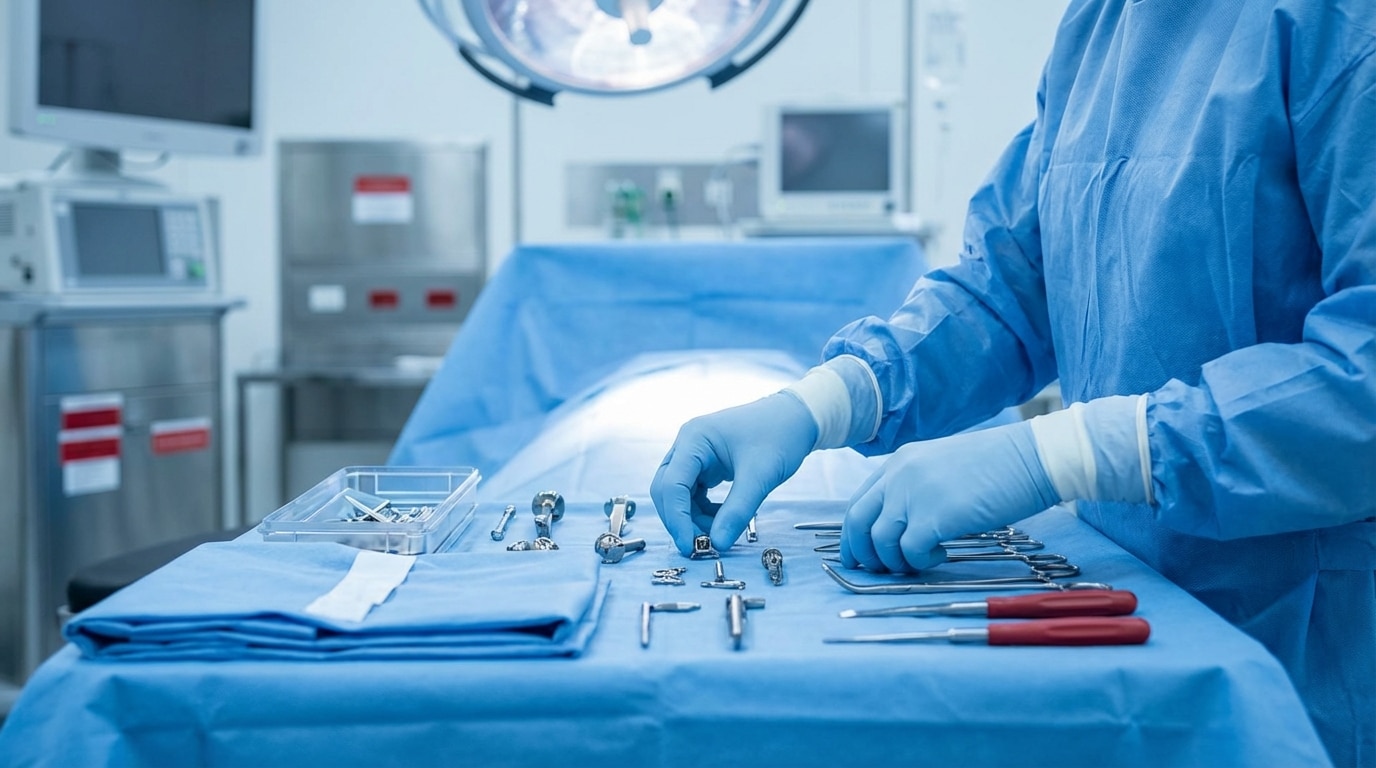
When a surgeon uses your company’s implants or instruments in a surgical procedure, you are in the operating room. Not scrubbed in. Not operating. But present, gowned, and available. You are there to:
- Ensure the correct implant set is in the room. Before the patient is wheeled in, you have verified that every tray, every size, every instrument is present and accounted for. If the surgeon needs a 6.5 x 45mm pedicle screw during a posterior lumbar fusion, that screw needs to be on the back table. Not in your car. Not at the warehouse. On the table.
- Provide intraoperative technical support. Surgeons ask questions during cases. Which implant trial fits best for this anatomy? What is the recommended torque spec on that set screw? Is there a longer option available? You need to know the answer immediately, because the patient is open on the table and the surgeon is not going to wait while you call tech support.
- Assist with instrument assembly and setup. Many implant systems have modular components that need to be assembled in sequence. Scrub techs vary in their familiarity with your specific system. You guide them through the setup, hand off instruments in the correct order, and troubleshoot any issues with the instrumentation during the case.
- Document implant usage. Every implant that goes into a patient must be documented — lot numbers, catalog numbers, sizes, quantities. This feeds into billing, inventory replenishment, regulatory tracking, and the hospital’s medical record. You own this documentation.
Case coverage is physically demanding. You are standing for hours. The OR is cold. You are wearing lead if fluoroscopy is being used. You cannot check your phone. You cannot leave. And if the case goes long or complications arise, you stay until it is done.
For a detailed breakdown of what this looks like hour by hour, read a day in the life of an orthopedic device sales rep.
2. Inventory Management
This is the function that separates good reps from great ones, and it is the function that most people outside the industry do not even know exists.
Medical device reps are responsible for managing the inventory that lives in their territory. Depending on the company and the model, this can mean:
- Consignment inventory at hospitals. Many hospitals hold consigned implant sets from device companies. These sets belong to the company (or distributor), not the hospital. The rep is responsible for knowing exactly what is in each set, ensuring sets are complete and sterile, and rotating stock before expiration dates.
- Loaner sets. For cases at facilities without consignment, the rep arranges loaner trays. This means coordinating with the company’s logistics team to ship the correct sets to the correct facility in time for the case. In spine and trauma, this can involve 8-15 trays for a single procedure.
- Trunk stock. Some reps carry product in their vehicles — typically smaller implants, biologics, or disposable instruments that might be needed on short notice. This requires careful tracking and compliance with storage requirements.
- Replenishment. After every case, implants that were used need to be replaced. You submit usage reports, reorder consumed inventory, and ensure the set is complete before the next case. A tray that goes to the next case missing a critical size is your failure.
Inventory management is unglamorous and relentless. It is also the reason surgeons stay loyal to specific reps. When your inventory is always right and always available, surgeons trust you. When it is not, they find someone else.
3. Selling: New Business Development
Yes, device reps sell. But the selling process in medical devices looks nothing like enterprise software sales or pharmaceutical detailing.
In medical devices, selling is a long-cycle, relationship-driven, clinically-grounded process. You do not cold-call a surgeon and pitch a product over lunch. You earn the right to present your product by demonstrating clinical knowledge, reliability, and genuine value to the surgeon’s practice.
The sales process typically follows this progression:
- Identification. You identify a surgeon who is using a competitor’s product or who has an unmet clinical need that your product addresses.
- Access. You get in front of the surgeon. This might happen through a referral from another surgeon, through the hospital’s value analysis committee, through industry events, or through a clinical education program your company sponsors. Cold outreach works occasionally, but warm introductions are the currency.
- Clinical presentation. You present your product’s clinical data, design features, and surgical technique. This is not a PowerPoint in a conference room. It is often a conversation in a hallway between cases, a cadaver lab demonstration, or a peer-to-peer discussion where the surgeon hears from another surgeon who uses your product.
- Evaluation. The surgeon agrees to try your product. You arrange a trial case. You are in the OR for that case, making sure everything goes perfectly. The surgeon evaluates the instrumentation, the implant performance, and the overall experience.
- Adoption. If the trial goes well, the surgeon begins using your product regularly. You work with the hospital to get the product on formulary, negotiate pricing, and establish consignment or ordering protocols.
- Retention. The sale is not a one-time event. You retain the surgeon’s business by continuing to provide excellent case coverage, staying current on clinical data, bringing new products to their attention, and being available when they need you.
This entire cycle can take 3 to 18 months per surgeon. In some cases, years. Patience is not optional.
4. Surgeon and Staff Relationships
Relationships in device sales are not a soft skill. They are the operating system.
Your relationship with the surgeon determines whether you get access to cases, whether the surgeon tries new products, whether they call you or your competitor when they have a question, and whether they advocate for your product in hospital committee meetings.
But surgeons are not your only critical relationships. The OR staff — scrub techs, circulating nurses, surgical PAs, OR schedulers — are equally important to your daily success. The scrub tech who knows your instrument system saves you time and reduces errors. The OR scheduler who gives you a heads-up on case additions keeps you from missing coverage. The circulating nurse who trusts you will let you know when a competitor is trying to get in the door.
These relationships are built through consistency. Show up. Be prepared. Know your products. Do not waste anyone’s time. Do not be the rep who brings donuts but cannot answer clinical questions. Do not be the rep who disappears when a case goes sideways.
5. Administrative and Compliance Work
The unglamorous backbone of the job:
- CRM updates. Logging calls, updating pipeline, recording case notes. Most reps hate this. Most companies require it.
- Expense reporting. Device reps have significant expenses — travel, meals, samples, conference attendance. Tracking and submitting these accurately is part of the job.
- Credentialing. Every hospital requires reps to be credentialed before they can enter the OR. This involves background checks, HIPAA training, infection control training, vendor credentialing through services like Reptrax, Vendormate, or IntelliCentrics. Maintaining current credentials at every facility in your territory is a continuous administrative task.
- Compliance training. AdvaMed code of ethics, anti-kickback statute requirements, Sunshine Act reporting, FDA promotional guidelines. You need to know what you can and cannot do, say, and provide. The consequences of getting this wrong are career-ending.
- Pricing and contract support. Working with hospital procurement on pricing, supporting GPO contract negotiations, preparing quotes for value analysis committees.
How the Job Differs by Specialty
Not all device rep roles are the same. The specialty shapes the daily experience significantly.
Orthopedic Reconstruction (Joints)
Cases are scheduled. The OR experience is relatively predictable. Joint replacement procedures follow established protocols. Your product line is focused — hips, knees, maybe shoulders. Case duration is typically 1-2 hours. Volume can be high. The selling conversation centers on implant design, surgical technique, and robotic platforms. Robotics is increasingly central to joint selling in 2026.
Spine
Cases are longer (2-8 hours), more complex, and more instrument-intensive. A single posterior lumbar fusion requires 8-15 trays. You need deep technical knowledge of pedicle screw systems, interbody cages, biologics, and navigation technology. Call obligations are common. The comp tends to be higher because the barrier to entry is higher.
Trauma
Emergent. Unpredictable. You are on call. A femur fracture at 2 AM means you are at the hospital at 2 AM with the correct nail set. The product catalog is massive because trauma covers every bone and every fracture pattern. It is the best training ground in device sales, but it demands a lifestyle commitment that not everyone can sustain.
Sports Medicine
Faster cases, higher volume, growing ASC presence. Arthroscopic procedures are typically 30-90 minutes. The product set is heavily disposable — anchors, shavers, cannulas, fluid management. The selling cycle can be shorter because surgeons can trial products more easily. The ASC environment is less bureaucratic than hospitals.
Biologics
Biologics reps often operate as a supplement to hardware reps rather than a standalone role. The product set — bone graft, amniotic tissue, PRP kits, skin substitutes — is used across multiple surgical specialties. The selling conversation is more clinical and evidence-based because biologics require data to justify their cost and usage.
W-2 vs. 1099: How Employment Model Changes the Job
Everything described above applies regardless of whether you are a W-2 employee of an OEM or a 1099 independent rep working through a distributor. But the experience diverges in important ways.
W-2 reps have a defined territory, a salary floor, company-provided benefits, and a manager who sets expectations. The company handles inventory logistics, billing, compliance infrastructure, and training. You focus on selling and covering cases. The tradeoff is that you do not own anything. Your territory can be split. Your comp plan can change. Your employment is at-will.
1099 reps are running a business. You choose your product lines. You manage your own expenses, taxes, and insurance. You have more control over your schedule and your territory. But you also carry more risk. No salary floor. No benefits. No safety net if a product line gets pulled or a surgeon retires. The upside is uncapped income and equity in a book of business you own.
Most new reps start W-2 and transition to 1099 after gaining experience and building surgeon relationships. The transition point is typically 3-7 years in, when the rep has enough established business to sustain the switch. For more on this decision, see our guide on how to break into medical device sales.
What Makes a Great Medical Device Sales Rep
After 10+ years of watching reps succeed and fail in this industry, the pattern is consistent. The reps who thrive share a specific set of traits that have nothing to do with charisma or closing techniques:
- Clinical curiosity. They genuinely want to understand the surgery, the anatomy, the biomechanics. Not because they have to. Because they are interested. Surgeons can tell the difference.
- Operational discipline. Their trays are always complete. Their inventory is always accurate. Their implant documentation is always clean. They do not cut corners on the unglamorous work.
- Emotional steadiness in the OR. The operating room is a high-pressure environment. Things go wrong. Surgeons get frustrated. The rep who stays calm, solves problems quickly, and does not add stress to the room earns trust that no sales technique can replicate.
- Long-term relationship thinking. They do not sell a product and disappear. They invest in relationships over years. They remember details. They follow up without being asked. They show up when there is nothing to sell because showing up is the point.
- Tolerance for ambiguity and disruption. Your schedule is not your own. Cases get added, canceled, and moved. Surgeons run late. Product gets delayed. The rep who needs structure and predictability will struggle. The rep who adapts in real time will excel.
What Medical Device Sales Reps Do Not Do
Clearing up common misconceptions:
- They do not perform surgery or touch the patient. Reps provide technical guidance on instrumentation and implants. They do not scrub in, handle tissue, or make clinical decisions. The line is clear and legally defined.
- They are not pharmaceutical reps. Pharma reps visit offices, drop samples, and discuss prescribing data. Device reps are in the OR during live surgery. The skill set, the daily experience, and the comp model are completely different.
- They do not just “drop off product.” This is not FedEx. The value a device rep provides is clinical knowledge, intraoperative support, and inventory management. If the job were just delivery, it would not pay what it pays.
- They are not traditional salespeople. There is no door-to-door. No cold-calling campaigns. No script. The selling process is technical, consultative, and built on clinical credibility.
Frequently Asked Questions
Do medical device sales reps need a medical or science degree?
No. Most reps do not have medical degrees. A bachelor’s degree is typically required, but the major is less important than the skills you bring. Biology, kinesiology, and exercise science graduates have an advantage in understanding anatomy, but business, communications, and engineering graduates succeed equally. What matters more is clinical aptitude, coachability, and the ability to learn complex product systems quickly.
How many hours per week does a medical device sales rep work?
Expect 50-60 hours in a typical week, with significant variability. Weeks with heavy case schedules or add-on surgeries can push to 70+. Trauma and spine reps tend to work more hours due to emergent cases and call obligations. The hours are also unpredictable — a 5 AM case start or a late Friday afternoon add-on is normal. This is not a 9-to-5 career.
What is the hardest part of being a medical device sales rep?
Most reps cite the combination of schedule unpredictability, the pressure of being in the OR during live surgery, and the long sales cycles. Building a territory from scratch while managing case coverage and inventory across multiple facilities is a sustained grind. The reps who struggle most are those who underestimate the operational and logistical demands and overestimate the selling component.
Can medical device sales reps work remotely?
No. This is a field-based role. You are physically present in operating rooms during surgical cases. You are at hospitals meeting with surgeons, OR staff, and procurement. You are transporting and managing instrument sets. Administrative work — CRM updates, email, expense reports — can be done from home, but the core job requires physical presence in clinical settings every week.